

Tartarus (/ˈtɑːrtərəs/, TAR-tuh-ruhs) is Avium’s southernmost and smallest continent. It is bounded on the west by the Western Panthalassan Ocean and on the east by the Eastern Panthalassan Ocean, acting as a partial barrier that channels water exchange between the two oceanic basins. It contains the geographic South Pole. Tartarus is the least explored continent on Avium and is characterized by the lasting effects of the Second Impact, a cataclysmic bolide strike during the Late Eocene (~35 mya). The event fractured the continental craton to form the Tartarean Rift, a marine-inundated multi-ring hybrid between an impact crater and an abyssal trough that strongly influences global thermohaline circulation and sustains isolated, chemotrophic ecosystems.
Geography
Hydrography
Tartarus physically bisects the southern reaches of the Western and Eastern Panthalassan Oceans, preventing the formation of a singular circumpolar current. Instead, the continent forces interbasin exchange through two discrete gateways located within the Tartarean Rift and at its diametric antipode. These passages act as the primary controls on meridional overturning circulation, regulating the transfer of heat, salt, and nutrients between Avium’s two major oceanic basins.
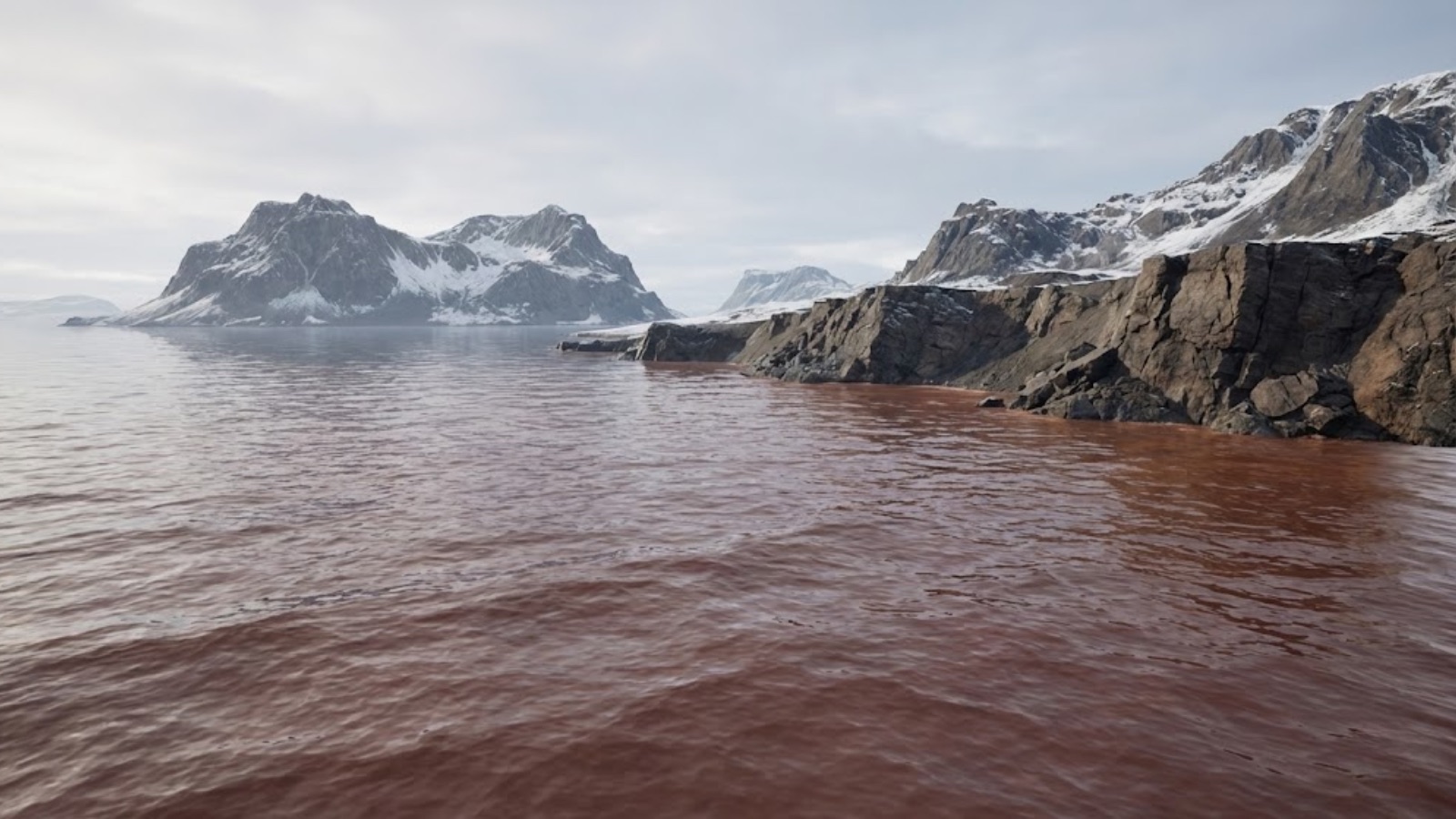
The gateway within the Tartarean Rift functions as a high-pressure geothermal engine driven by intense heat flux from the fractured Tartarean craton. Lithospheric thinning caused by the Second Impact permitted sustained mantle upwelling, establishing a large-scale vertical convection system that draws cold abyssal water into the crust and returns it to the surface through hydrothermal vents. As plume waters enter oxygenated surface layers, mantle-derived iron and sulfur are introduced into the water column; dissolved ferrous iron oxidizes rapidly into ferric oxyhydroxides, producing a persistent regional red turbidity. The system discharges warm, chemically modified waters northward, exporting mineral nutrients into the broader ocean.
The Antipodal Gateway is a more conventional oceanic exchange zone where the Western and Eastern Panthalassan Oceans meet across a submerged, geologically stable continental shelf. Circulation there is governed by baroclinic pressure gradients and tidal forcing, providing a contrasting pathway for interbasin mixing without significant geothermal influence.
At the planetary scale, geothermal upwelling at the Tartarean Rift suppresses local deep-water formation and displaces bottom-water production to other regions, imprinting a Tartarean thermal and chemical signature on the Panthalassan deep ocean. The resulting redistribution of iron- and sulfur-enriched waters reduces micronutrient limitation across large areas of the global ocean, increasing baseline productivity and strengthening coupling between ocean circulation and biogeochemical cycles.