
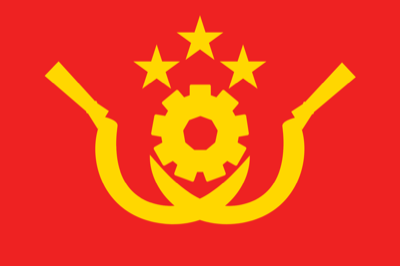
Rudania (Рудания, Roo-dah-nee-ya) officially known as the People's Republic of Rudania, is a country that lies in both Valtheria and Evria. It is bound by the Arctic Ocean to the west and the Hyperborean Ocean to the north-west. It shares land borders with Karjania, Livonia, Cortesia, Sidanya, and Polabiny to the south, and with Nichirin and Axerfreditenshin in the North. It is the largest country in the world by land area, and is divided into 9 Provinces. It has a population of 111 million. Its capital city is Radagorsk, with a population of 11 million.
Etymology
The word Rud comes from the Tribe of Rud, a Skjarnish raider tribe which conquered central Rudania in the 12th century. -an is Rudanian for of/from, and -ia/-ya is a suffix meaning land. Altogether, Rudania means Land of the Rud.
Military
The People's Revolutionary Army (Народная Революционная Армия Рудании, “Narodnaya Revolyutsionnaya Armiya””) or the NRA, serves as the armed forces of the People's Republic of Rudania. It is divided into three branches, the People's Army (Narodnaya Armiya), the People's Navy (Narodny Flot), and the People's Air Force (Narodnye Vozdushnyye Sily).
The NRA falls under the People's Directorate, specifically the National Defense Commissariat, led by the Commissar for National Defense, who is also known as the Commander-in-Chief of the People's Revolutionary Army. This role is currently filled by the Chief Commissar of the People's Directorate.
The NRA prefers human wave tactics and uses masses of infantry and armour to launch coordinated, simultaneous attacks across a front line.
After the Civil War, the State invested massively into the NRA. It is a rapidly growing and modernizing military. New technologies are being developed, and mass recruitment drives are active across the country.
Government
The People's Republic of Rudania is a one-party, totalitarian communist state. The highest governing body of the country is the National People's Directorate, which is elected by the Common Assembly every 5 years. Although the Common Assembly is meant to be an independent legislative body, in reality, only members of the People's Revolution Party and its allied parties are allowed to hold seats. Real power lies with the National People's Directorate and its 25 or so members, each holding the title of Commissar, and assigned a portfolio by the Chief Commissar, such as Industry, Agriculture, Health, etc.
Rudania is divided into 9 Provinces, which are further subdivided into districts. Each province and district has its own People's Directorate, called a Provincial People’s Directorate and a District Directorate, respectively. Provincial People's Directorates are led by a Provincial Commissar, appointed by the National People's Directorate. District Commissars are then chosen by the Provincial Commissar.
The judiciary is known as the State Revolutionary Court, a holdover from the times of the revolution (where it was called the Revolutionary Tribunal), which has been restructured into the main judicial branch of the government. It is led by a Supreme Justice, who oversees and appoints High Justices. Each High Justice oversees the Revolutionary Court of a province. Below the High Justices are the Justices, who are in charge of District Courts. The Supreme Justice is appointed by the Chief Commissar.
Economy
Rudania operates a centrally planned economy under the authority of the State Planning Bureau, which reports to the Kommissariat für Industrie und Produktion. All major decisions regarding what to produce and how much are made centrally and then passed down to regional administrators. Private ownership of the means of production is a criminal offense. The entire industry is owned and operated by the state.
Heavy Industry is the main focus of the economy. The majority of state investment is poured into steel foundries, coal mines, iron works, and machine production. The largest industrial hubs are located in the river basins throughout central Rudania.
Mining is also an essential component of the economy. Rudania sits atop massive reserves of coal, iron, and other industrial metals, such as nickel. The mining sector is organized into massive state enterprises employing hundreds of thousands of workers in frequently dangerous conditions.
Rudania also has large reserves of oil and natural gas, although the infrastructure to exploit them is currently poor. Recent state initiatives have expanded the oil and gas sector, and it is projected to grow further over the coming years.
Foreign trade is limited. Rudania exports only to trusted allies.
Geography
Topography
Rudania is the largest country in the world by land area, and its topography is wide and varied. It can be roughly divided into 5 zones.
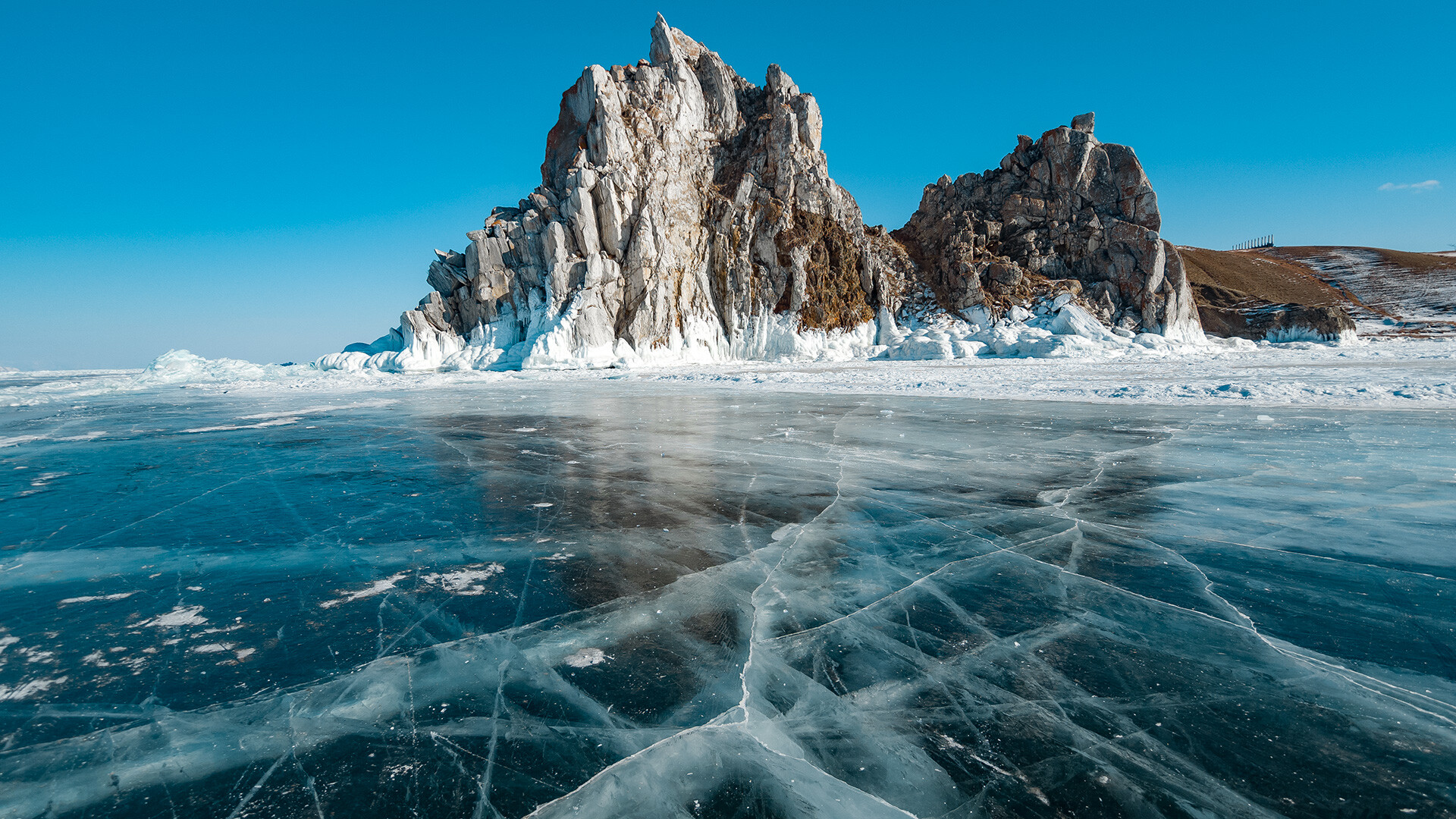
The Rudanian Heartland is the southernmost portion of Rudania. It is composed almost entirely of flat, fertile plains. It is densely populated and criss-crossed with many rivers. The major river-system that runs through the heartland is the River Volzha, around which most of the largest cities in Rudan are located. It is bound by the Boryav mountain range to the North. The Boryav mountains are rich in mineral resources, and have an average elevation of 1000-1200m, stretching for 2100 kilometres East to West.
The Southern Spatryan Plains begin just north of the Boryav Mountains and are home to some of the largest floodplains and marshes in the world. They stretch 1900 km north to south and 2400 km West to east. It is largely flat and featureless. It is densely forested and sparsely populated. In its Eastern regions, the taiga gives way to the steppe. It also holds massive oil and gas reserves.
The Central Spatryan Plateau is further north of the Spatryan Plains. It is divided into a series of plateaus with elevations ranging from 320 to 740m. The terrain is rugged and broken, with deep river valleys cutting through much of it. Most of Rudania’s mineral wealth is present here.
Dal'nya is the northernmost region of Rudania. It is almost completely inhospitable, with freezing temperatures and little to no vegetation. The Studenaya basin is its lowest and coldest point. The Kholodny highlands surround it, trapping cold air and further reducing the temperature. Some mineral reserves are present here, mainly gold and diamonds, which have led to some human habitation.
The Arctic West is the westernmost part of Rudania. It is the only part of Rudania with a coastline on the Arctic Ocean. This has made it strategically important, and so it is inhabited despite its climate. Its coastline is rugged, with hundreds of small inlets and fjords dotting the shore. Much of the water is frozen over during the winter months. Some small archipelagos and islands also hover just off the coast.
Climate
The Rudanian climate is varied due to its large size. In the Heartland and some parts of the Spatryan Plains, a humid continental climate exists.
The interior of Rudania experiences severe continental weather due to the lack of large bodies of water to moderate it. Winters are long, dark, and brutally cold.
Dal'nya has some of the most extreme climatic conditions on the continent. It exhibits a continental sub-arctic climate.
The Arctic West has a sub-arctic maritime climate, much less extreme than Dal’nya, thanks to the moderating effects of the sea.
Precipitation is moderate in the heartlands and the southern sections of the Spatryan Plains, but low everywhere else.
Demographics
Ethnic Groups
The dominant ethnic group in Rudania is Rudan (82.32%). They largely inhabit the Heartland and the Southern Spatryan Plains. They are politically and economically powerful, as most government officials are Rudan.
The Kheravi inhabit the steppes of the South Spatryan Plain, and they hold little to no power in government due to their highly dispersed society.
The Brestovi are a group descended from the early Rudan tribes, which migrated to the Arctic Sea in the 1200s. They are a maritime culture, and children are often taught to fish and sail at a young age.
The Mirovi inhabit the southern part of the Rudanian Heartland and are fiercely independent. They produce disproportionate numbers of soldiers and warriors, and were once an independent country before being absorbed into Rudania during the 18th century. They are granted greater liberties than other groups to practice their traditions, and many serve in the Rudanian Armed Forces.
Languages
Rudanian is the official state language of Rudania and is spoken by a majority of the population.
Other languages include Kheravi, Brestovi, and Mirovi. These languages are not used by the state, but the government recognizes them as regional languages.
Religion
Sorovite Nazarism is the most popular religion in Rudania. It is a branch of Ecclesiarchal Nazarism that split off from the Ecclesiarchal Church several centuries ago. It is traditionally led by a High Patriarch, but the post has been unoccupied since the revolution.
Many Rudanians living on the North Spatryan Plateau and in other remote areas of Rudania practice old folk religions that deify ancestral spirits and nature.
Since the Revolution, the state has launched initiatives to move the people away from religion, and although these attempts have been largely unsuccessful, many Rudanians now identify as atheists.
Citizenship
Rudanian citizenship is automatically conferred to all children born to two Rudanian parents. Although half Rudanian children are not automatically granted citizenship, they can still apply for citizenship. Foreigners can only be granted citizenship at the discretion of the National People's Directorate.