
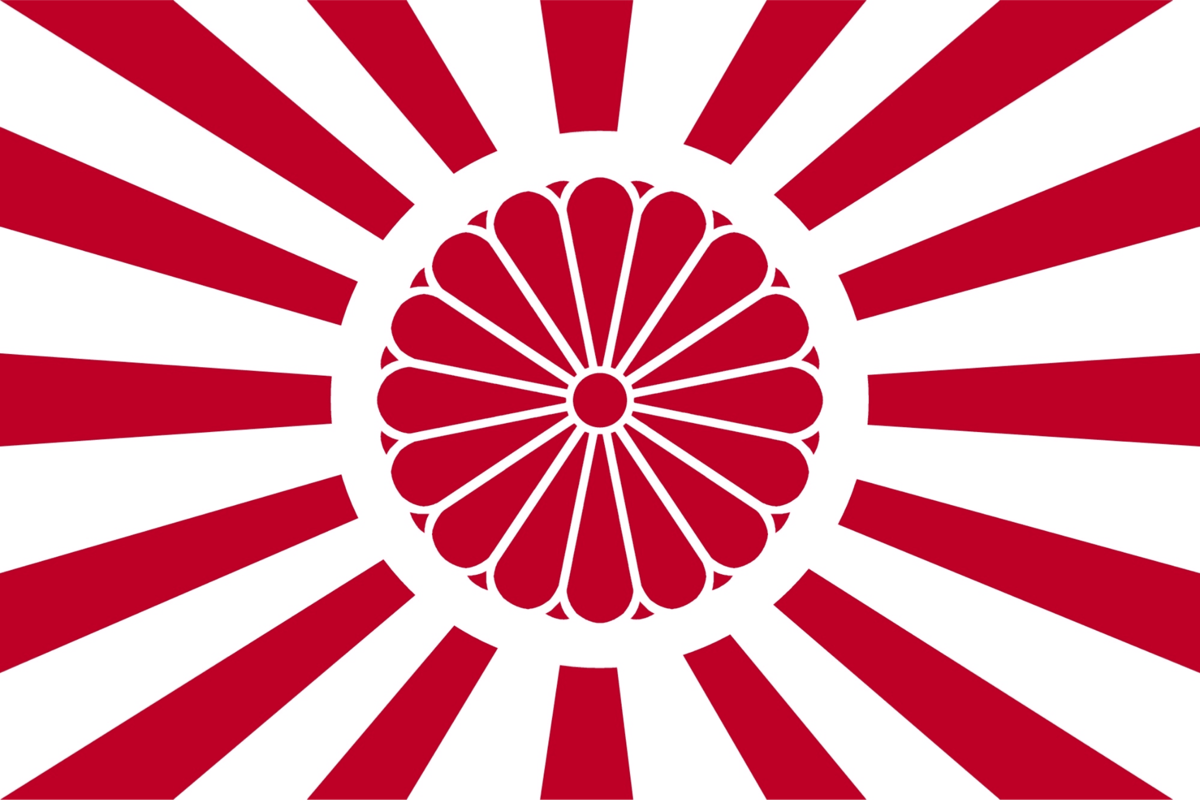
The Shogunate Armed Forces (武幕軍, Bubakugun; SAF) serves as the military of Nichirin and the ruling Bakufu. It is organized into three principal branches: the Ground Corps (陸軍, Rikugun), the Naval Corps (海軍, Kaigun), and the Aerial Corps (航空軍, Kōkūgun).
History
The SAF traces its origins to the Age of Chaos, initially established as the military forces of the Miyamoto clan during the period of continuous civil war among provincial daimyo. Under the leadership of Mukaimasa Miyamoto, the clan's forces distinguished themselves through superior organization, disciplined infantry formations, and the effective use of combined-arms tactics integrating cavalry, arquebusiers, and pike formations. The army prioritized meritocratic promotion over hereditary status, recruited talented commanders from defeated rivals, and maintained strict logistical systems that ensured sustained operational capability during extended campaigns. These innovations proved decisive, especially at the Battle of Shizuhata in 1603, where Miyamoto forces defeated a numerically superior coalition through superior battlefield coordination and tactical flexibility, ending the Age of Chaos and establishing the Miyamoto Shogunate.
Throughout the 18th century, the Shogunate pursued an interventionist foreign policy in Manshu, culminating in costly military campaigns between 1764 and 1802 against the Xing Dynasty. Shogunate forces achieved initial success through superior firearms technology and infantry tactics, penetrating deep into Xing territory and capturing several strategic fortress-cities. However, the Xing military adapted by implementing defensive-depth strategies, trading territory for time while exhausting Shogunate supply lines stretched across vast continental distances. Xing forces also employed scorched-earth tactics, guerrilla warfare, and seasonal counteroffensives that exploited harsh winter conditions unfamiliar to Nichirian troops. Neither side could achieve a decisive strategic victory: the Shogunate lacked the manpower to permanently occupy and hold conquered territory, while the Xing Dynasty could not expel Nichirian forces from fortified positions in contested border regions. The resulting stalemate exhausted the shogunate's treasury and manpower, contributing to widespread discontent, grain shortages, and peasant riots in the early 19th century.
In 1868, the Imperial Court attempted to reclaim political power from the Shogun, triggering the Bakuraku War. Imperial loyalists, supported by several disaffected domains and lower-ranking samurai, launched coordinated uprisings in modern-day Metropolitan Nichirin, declaring the restoration of direct imperial rule while Shogun Makoto Miyamoto was abroad. The rebellion initially caught the Shogunate by surprise, seizing control of Chiyoda Castle (Makoto’s residence) and the surrounding Shiomachi Ward, proclaiming Emperor Kasuga as the legitimate sovereign. However, the rebellion collapsed after a seven-day siege in which Shogunate forces, led by Aratame Jōzui, employed modern artillery against the castle complex, decimating its defenses and setting much of the structure ablaze. Shogunate infantry stormed the ruins on the final day, capturing Emperor Kasuga attempting to flee through underground passages. The Emperor was tried for treason and publicly executed, while the destroyed Chiyoda Castle was later rebuilt as the Palace of the Solar Halo.
The SAF participated in the Great War against the Xing Empire, initially facing severe setbacks against Xing human-wave tactics that overwhelmed defensive positions through sheer numerical superiority, despite catastrophic casualties. Xing commanders demonstrated a willingness to accept extraordinary loss ratios, sending massed infantry formations against entrenched Nichirian positions in repeated frontal assaults that gradually exhausted the defenders. The strategic situation shifted after Nichirian naval and aerial forces established maritime superiority in the Bay of Serica and air superiority over Manshu. Naval bombardment suppressed Xing coastal defenses and enabled amphibious operations that outflanked Xing defensive lines, while aerial reconnaissance provided accurate intelligence on Xing troop concentrations and supply routes. The SAF fully repelled the Xing incursion in late 1918 and captured Beixing in 1919, forcing the Xing Empire to capitulate and establishing Nichirin as the dominant regional power in Valtheria.
Structure
Masashi Miyamoto, the Shogun, serves as Commander-in-Chief of the Shogunate Armed Forces, holding supreme constitutional authority over all military matters. Military authority runs from the Shogun to the cabinet-level Minister of Defense, Toranosuke Saionji. The Shogun and Minister of Defense are advised by the three service Marshals, who collectively form the Supreme Military Council (最高軍事会議, Saikō Gunji Kaigi): Marshal-General of the Bulwark (元帥堅塁大将, Gensui Kenrui Taishō) Kiyoshi Kiryū, Marshal-Admiral of the Maelstrom (元帥渦潮提督, Gensui Uzushio Teitoku) Suiren Makinami, and Marshal-Commodore of the Firmament (元帥蒼穹代将, Gensui Sōkyū Daishō) Hayato Aotaka. The Marshals function as chiefs of staff for their respective branches and hold the highest military rank in the SAF. Only one officer per branch may hold the Marshal designation at any given time. Each service branch operates under its respective Marshal's administrative control.
The SAF operates through five regional Theater Commands, each led by an officer at the O-9 or higher pay grade. Theater Commands are broadly responsible for strategy, planning, operations, and policy within their designated regions. During wartime, theater commanders exercise direct operational control over all subordinate units within their area of responsibility. In peacetime, subordinate units maintain dual reporting structures to both their theater command and their respective service headquarters. The service branches retain administrative authority and are responsible for force development. The SAF maintains five Theater Commands, presented in order of precedence:
The Eastern Theater Command, headquartered in Mizuhara and commanded by Marshal-General Kiyoshi Kiryū, is responsible for the majority of the Manshu region. The Manshuan TC manages the border with Jiuhe and protects Nichirin's industrial heartland. Presently, the Manshuan TC maintains extensive fortification networks and conducts joint border patrols as established during the Niiyama Conference.
The Tohanto Theater Command, headquartered in Naginomiya and commanded by Admiral Ichiro Enkanohama, is responsible for the Tohanto region, the Rensei Islands, and projecting Nichirian influence over the northeastern Panthalassan Ocean. The Tohanto TC oversees naval operations in the Bay of Serica and manages coastal defense installations along the eastern seaboard.
The Southern Theater Command, headquartered in Yoshino and commanded by General Kozue Gushiken, is responsible for the southern regions of the nation. The Southern TC oversees Sangai and Southern Manshu, managing Nichirin's longest land border with Rudania.
The Metropolitan Theater Command, headquartered in Shinkeisei and commanded by Marshal-Admiral Suiren Makinami, is responsible for the defense of Metropolitan Nichirin and the capital city, Shinkeisei. The Metropolitan TC serves as the nation's strategic military reserve and is primarily tasked with protecting the nation's economic core.
The Western Theater Command, headquartered in Satsuno and commanded by Marshal-Commodore Hayato Aotaka, is responsible for far western Metropolitan Nichirin, Karafuto, and the Northern Kurile Islands, as well as projecting Nichirian influence over the Hyperborean Ocean and the continent of Hyperborea. The Western TC maintains forward operating bases in extreme polar environments.
Ranks
| Pay Grade | Ground Corps | Naval Corps | Aerial Corps |
|---|---|---|---|
| O-10 |  元帥堅塁大将 Marshal-General of the Bulwark |  元帥渦潮提督 Marshal-Admiral of the Maelstrom |  元帥蒼穹代将 Marshal-Commodore of the Firmament |
| O-9 | 大将 General | 提督 Admiral | 代将 Commodore |
| O-8 | 中将 Middle General | 中提督 Middle Admiral | 中代将 Middle Commodore |
| O-7 | 少将 Junior General | 少提督 Junior Admiral | 少代将 Junior Commodore |
| O-6 | 大副官 High Adjutor | 海大副官 High Sea-Adjutor | 空大副官 High Air-Adjutor |
| O-5 | 中副官 Middle Adjutor | 海中副官 Middle Sea-Adjutor | 空中副官 Middle Air-Adjutor |
| O-4 | 少副官 Junior Adjutor | 海少副官 Junior Sea-Adjutor | 空少副官 Junior Air-Adjutor |
| O-3 | 大司令 High Commandant | 大艦長 High Skipper | 大飛行士 High Aviator |
| O-2 | 中司令 Middle Commandant | 中艦長 Middle Skipper | 中飛行士 Middle Aviator |
| O-1 | 少司令 Junior Commandant | 少艦長 Junior Skipper | 下飛行士 Low Aviator |
| E-7 | 特務軍曹 Master Sergeant | 大上等兵曹 Master Chief Petty Officer | 特務空曹 Master Sergeant |
| E-6 | 一等軍曹 Staff Sergeant | 上等兵曹 Chief Petty Officer | 一等空曹 Staff Sergeant |
| E-5 | 二等軍曹 Sergeant | 一等兵曹 Petty Officer First Class | 二等空曹 Sergeant |
| E-4 | 伍長 Corporal | 二等兵曹 Petty Officer Second Class | 空兵長 Leading Airman |
| E-3 | 矛伍長 Spear Corporal | 三等兵曹 Petty Officer Third Class | 上等空兵 Senior Airman |
| E-2 | 一等兵 Private First Class | 一等水兵 Seaman | 一等空兵 Airman |
| E-1 | 二等兵 Private Second Class | 二等水兵 Seaman Apprentice | 二等空兵 Airman Apprentice |
Statistics
Ground Forces
| Category | Type | Count | ||
|---|---|---|---|---|
| Outdated | Modern | Advanced | ||
| Infantry | Fit-for-Service | 104,000,000 | ||
| Active Personnel | 2,900,000 | |||
| Reserve Personnel | 7,250,000 | |||
| Paramilitary | 0 | |||
| Armor | Cavalry | 45,340 | ||
| Armored Cars | 823 | 1,184 | 210 | |
| Tankettes | 1,387 | 1,823 | 210 | |
| Light Tanks | 1,224 | 1,189 | 434 | |
| Medium Tanks | 587 | 614 | 182 | |
| Heavy Tanks | 82 | 41 | 0 | |
| Artillery | Field Guns | 4,021 | 5,087 | 1,035 |
| Heavy/Siege Artillery | 812 | 784 | 227 | |
| Anti-Aircraft Guns | 823 | 1,587 | 437 | |
| Anti-Tank Guns | 614 | 1,423 | 399 | |
| Mortars | 5,124 | 8,937 | 2,223 | |
| Support | Vehicles | 161,240 | ||
| Engineers | 161,341 | |||
| Signal Corps | 100,249 | |||
Naval Forces
| Category | Type | Count | ||
|---|---|---|---|---|
| Outdated | Modern | Advanced | ||
| Capital Ships | Battleships | 4 | 6 | 2 |
| Light Cruisers | 5 | 26 | 19 | |
| Heavy Cruisers | 4 | 18 | 12 | |
| Battlecruisers | 1 | 2 | 2 | |
| Carriers | Fleet Carriers | 0 | 2 | 4 |
| Light/Escort Carriers | 0 | 3 | 3 | |
| Smaller Vessels | Destroyers | 23 | 117 | 55 |
| Torpedo Boats | 31 | 61 | 11 | |
| Submarines | 16 | 60 | 21 | |
| Gunboats | 51 | 62 | 11 | |
| Support | Transports | 71 | ||
| Logistics Vessels | 122 | |||
Air Forces
| Category | Type | Count | ||
|---|---|---|---|---|
| Outdated | Modern | Advanced | ||
| Fighters | Biplane Fighters | 814 | 0 | 0 |
| Monoplane Fighters | 0 | 1,623 | 1,624 | |
| Bombers | Tactical Bombers | 0 | 1,214 | 1,223 |
| Strategic Bombers | 0 | 141 | 102 | |
| Attack Aircraft | 0 | 923 | 924 | |
| Support | Recon Aircraft | 307 | 612 | 294 |
| Transports | 507 | |||