
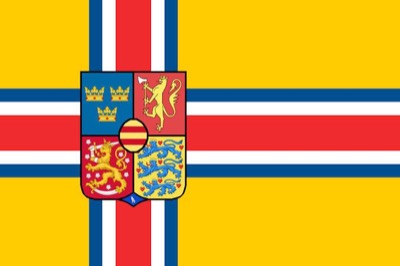
Skjarnland (Skee-arn-land), officially the Kingdom of Skjarnland, is a country in Northern Evria, bordering Karjania to the north, the Arctic Sea to the west, the North Sea and Alemannia to the south, and the Suebian Sea to the east. As of 1934, it is the 11th most populous nation on the continent and possesses the world's 21st highest GDP, 5th highest real GDP per capita (excluding overseas territories) and has the highest HDI in Evria. Its diverse climate, which includes temperate to arctic conditions, is a result of the country's latitudinal length stretching from the plains of Central Evria to the harsh tundra and cold desert of the Arctic regions. Skjarnland is a constitutional monarchy currently governed by the House of Dahlberg, with day-to-day affairs handled by the ruling coalition in the Riksdag, the nation's unicameral legislature. Skjarnland's ethnicities include all of the Northern Alemannic cultures, which form the vast majority of the nation's ethnic makeup, along with indigenous northern tribes such as the Sjaedrin and Iskarn peoples.
Etymology
The name for Skjarnland is generally agreed to have originated from the old Skjarn word skjǫldr, meaning shield. The word evolved into skyärn, referring to a shield-bearing warrior, later further evolving to refer to the warrior class prevalent in Skjarnland until the high medieval period. By the 10th century, sources from the Akenauer Empire began collectively referring to all of the region’s inhabitants as Skjarns, with the terminology spreading to the rest of Evria throughout the remaining medieval period.
The term Skjarnia was originally a political rather than geographic designation; following the proclamation of the Kingdom of Skjarnia in the 14th century, the royal administration adopted the term, initially meaning the ‘land of all Skjarns’, to refer to all territories governed under the realm of the crown. This was to distinguish them from neighbouring Norrvynia and Danyria. The modern term Skjarnland emerged following the Skjarnish Unification in the 16th century. Seeking a new term encompassing all the peoples of the region, the new government revived the older ethnogeographic concept of the ‘land of all Skjarns’ to represent the entirety of the new realm including Danyria and Norrvynia. From that point onward Skjarnland became the standard term for the unified state, while Skjarnia was mostly relegated to a geographic term for Skjarnland Proper, the homeland of the Skjarnian people.
History
Main article: History of Skjarnland
Prehistory
The earliest known settlement in modern-day Skjarnland dates back to approximately the 90th century BCE, when proto-Alemannic and Sjaedric tribes migrated northward from Central Evria through Danyria and westward from Karjania. Archaeological evidence from remnants of reindeer-hunting camps suggests that the first humans to inhabit Skjarnland Proper (also known as Skjarnia) were hunter-gatherer societies in what is now Skjarnland Proper’s southernmost province, Sydmark.
Following the conclusion of the Pleistocene and the beginning of the warmer Holocene epoch, the lands encompassing modern Skjarnland Proper and Danyria, previously infertile and rigid tundra, gradually warmed into temperate land suitable for permanent settlement by the 70th century BCE. The earliest evidence of agriculture in modern Skjarnland were discovered in Sydmark and Rådjurland in Danyria, dating back to the 60th century BCE. Settlements in the southern regions of Skjarnland were built around fertile river valleys and coastal regions and cultivated livestock and early grains, evolving into complex chieftain-based societies. During the same period, the northern regions closer to the Arctic circle remained inhospitable and unfit for permanent settlements, allowing for hunter-gatherer societies to remain, themselves developing a culture oriented around warrior clans competing for food, where power was centered around martial prowess and the ability to secure wealth and food for one’s followers. Contact between the northern tribes and southern chiefdoms is believed to have been defined largely by trade; northerners exchanged rare furs and meats for sums of grain.
The earliest known written mention of the peoples of Skjarnland by a foreign power was in 107 BCE, when Rumaic historian Ceaparius Vopiscus described them as ‘barbarians from the land north of Alemannia’ in the chronicle Alemannia. Despite the lack of evidence of any direct contact between Skjarnish tribes and the Rumaic Empire, archaeological findings indicate that indirect trade via Alemannian intermediaries almost certainly existed. Rumaic coins and manufactured goods discovered in modern Skjarnland from the 19th century onward and evidence of the existence of walrus ivory and Skjarnish iron in the Rumaic Empire supports this theory.
Early Kingdoms
Between the 1st and 4th centuries CE, the numerous chiefdoms existing in the region began consolidating into larger political confederations, motivated by the growth in population (from roughly 250,000 across modern-day Skjarnland in 300 BCE to roughly 600,000 in 200 CE) and trade networks. Several distinct cultural groups emerged during this period, including the Skjarnirs (in the lowlands of southern Skjarnland Proper), Danyrians (in the coasts and island chains of Danyria) and Norrvynians (in the fjords and mountains of Norrvynia). Authority remained highly decentralised and personal, reliant on military strength and achievements in battle. Rulers were expected to demonstrate martial prowess, defend trade routes and secure wealth for their subjects through trade or plunder, the latter achieved by leading war parties to ransack neighbouring lands. Securing wealth was also done through rewarding lands and slaves to retainers to maintain their loyalty. Alliances between clans were common but often dissolved as soon as leaders died.
By the end of the 4th century CE, the first true kingdoms formed in southern and central Skjarnland Proper and Danyria. The Kingdoms of Sjöland, Hjalland and Kroneland dominated trade in the Suebian sea and as a result, influenced culture, economy and politics in the surrounding regions. One of the earliest Skjarnish figures whose existence is generally undisputed by historians is Harald of Kroneland (c. 410-449) who is credited with constructing the first market settlements in the region around the Suebian sea including Malmhug and Hälsingberg.
Warfare between the Skjarnish states became frequent as competition over trade routes grew. One ruler, Jorund Iron-Hand of Eldasland (c. 483-513), conquered Southern and Central Norrvynia in a twelve-year-long campaign of plunder and subgujation, motivated by his father’s failed attempts to do the same, although his territorial gains were reversed soon after his death. However, during his rule, Jorund established religious institutions centered around the Asarian faith, the polytheistic belief system present in the region, as a devout follower. Asarianism had been present in the region for centuries, descended from the earlier forms of pagan faiths practiced by the first humans to settle in Skjarnland, and was highly localised.
Religious customs, rituals and prayers to specific gods differed from clan to clan, which Jorund sought to change. In 503 CE, as a tribute to the Asarian gods, he ordered the construction of major sanctuaries, known as hov, located deep in the Skjarnish mountain range, maintained by priests known as gydirs, who were granted land privileges and met regularly on a roughly biennial basis in Isdalen during meetings known as hovthing to settle theological disputes and agree on common rites, in addition to interpreting the judgment of gods and foretelling prosperity and calamity.

Despite no formal hierarchy being formed and Gydir remaining relatively independent, the Hov system was the first attempt in Skjarnland to establish common religious institutions across tribal and political boundaries, and was later adopted across much of Skjarnland by the 7th and 8th centuries due to its practical incentives; establishing Hovs gave rulers religious legitimacy and political prestige, and allowed them access to the wider Gydir network, whose members became knowledgeable in developments of the land and highly literate compared to the rest of society. This literacy rose as a necessity for the maintenance of religious records and genealogies.
The Hov system made Skjarnland more interconnected despite its political fragmentation, encouraging greater cohesion in the Asarian faith and giving rise to the idea of a cultural affiliation in otherwise independent kingdoms. The roles of Gydirs gradually expanded into diplomacy, including becoming intermediaries between states. Tangvik of Sadethov was one such Gydir who negotiated the Trossö Compromise in 658 that defined the borders between Hjalland and Kroneland, which still exist in the present. By the 8th century, advances in shipbuilding by Danyrian and Norrvynian sailors driven by the expansion of trade networks into the North and Arctic seas allowed for the construction of longboats that unlocked the ability to rapidly traverse open sea and move swiftly upriver. The Norrvynian War (710-719) demonstrated the first use of longboats in combat, where Eldaslandian forces’ use of them during the Siege of Tord proved vital to victory. From then on, the invention spread rapidly throughout the region.
Viking Age
In the summer of 731, Chieftain Rasmus of Hojlund led an expedition to Northumber in Brant in search of plunder following the widespread devastation of Norrvynia during the war. The wealth of many chiefdoms was left devastated while Norrvynia’s warrior culture was reinvigorated, culminating in Rasmus’ cross-sea raid. His war party of 100 landed on the isolated Nazarist monastery town of Godschurch in the northeastern region of Northumber, where more than 200 priests and other residents were executed. Wealth from the town church and houses were systemically looted, and roughly 40 women and children were seized as slaves. Rasmus returned to Stjärnvik with large amounts of wealth, concluding the earliest recorded Viking raid and beginning what modern historians refer to as the Age of Voyages. However, it is likely that at least several raids had occurred before 731 due to the proximity of Brant to Norrvynia and the postwar climate.

Rasmus’ expedition provided proof that foreign raiding yielded great returns, and word soon spread throughout the land. Norrvynian chieftains initially led efforts to plunder Brant, but were soon joined by landless lords and raiders known as farir along with Danyrian rulers. The drive to raid was exacerbated by the conquests of the Akenauer Empire in the late 8th century, which disrupted trade routes between the Skjarnish world and the rest of Evria, and incentivised compensating for trade losses by resorting to plunder. By 800, the frequency of raids prompted the states of Brant including Northumber and Midria to build coastal defences and attack Viking outposts on their soil, including the Siege of Tinemūtha (modern Tynemouth) which marked an early Brantish victory against the Vikings, but this only slowed them. They continued to not only raid frequently but begin integrating into Brantish society; early generations of raiders would go home to Norrvynia or Danyria immediately after their raids were completed, but beginning in the late 8th century, the raiders, part of whom became an elite raid-specialising warrior class called drengir, would begin staying overwinter and eventually permanently, taking advantage of the near-collapse of Northumber authority outside of their fortified castles. Vikings also began entering the service of Brantish rulers as mercenaries, especially during the Anglian War (808-812).
In 812, Harald Iron-Slayer, a farir and elite mercenary, demanded land and gold from his client King Alfred of Northumber in exchange for his near-decade of service. Alfred responded by rejecting this proposal and insulting Harald. Vengeful, Harald returned to Norrvynia and using his reputation as a skilled warrior, secured the support of 7 chieftains to organise an invasion of Brant to seize vast amounts of land to permanently settle. In 813 and 814 Harald embarked on a series of risky journeys to Skjarnia and Danyria in order to lobby for further support, most famously from the Danyrian ruler King Gudfred, and the senior gydir Erik of Tingvallahov, which succeeded. Harald returned to Northumber in 815 with a 7,000-strong army known as the Great Host. The Northumber armies were degraded from the recent Anglian War and dependent on the very mercenaries they were now fighting, and as such suffered multiple severe defeats, the final one at the attempted forest ambush on Harald’s armies in the Battle of Kensfield. The Host marched south to Midria and Anglia where they defeated both nation’s armies, which suffered from the same factors that had doomed Northumber’s, and sacked the country before returning north. The end of the Brantish campaign saw Harald distribute the large swathes of conquered territories to his remaining 6,000 soldiers who became lords (jarls), with larger towns and castles granted to higher-ranked or more accomplished soldiers. These territories were collectively known as Faraland, with Harald as its de-facto ruler. King Edward of Midria subsequently began a truce with the Anglians and the southern duchies, and started the construction of dozens of castle forts, aiming to fortify his territory and prepare an eventual methodical reconquest, but died in 819 before his plans could bear fruit.
By the 820s, Faraland suffered from disunity and local lords attempting independent conquests and raids, often against each other. With the aid of King Gudfred, Harald established the drengathing in 824 with himself as its head, which met irregularly in Tynmóth (Tynemouth) to settle disputes and coordinate military campaigns. The drengathing provided a pressure valve for disputing lords, who often had passionate debates and occasionally duelled, but often failed to stop particularly ambitious lords, and a lord’s chances of winning a dispute was heavily dependent on his personal reputation. This was especially true after Harald’s death in 831; he commanded personal loyalty over his subjects, initially nearly all former soldiers under his command. In 833, the first major civil war in Faraland began when Jarl Sigurd of Dyrhamn, a former general under Harald, proclaimed himself ‘king of Faraland’, a title which did not exist. Sigurd’s attempt to centralise the realm under his rule was thwarted in the Battle of the Mitt River, where a coalition of lords led by Jarl Erik Axehand of Joforvik, another former general of Harald, assembled during a drengathing, defeating and killing him. The Mitt War exposed the strengths and failings of the drengathing; it could unite lords against a powerful and ambitious one, but was highly decentralised and did not prevent open conflict.
In 836, King Edward II of Midria launched the First Reconquest, which saw early victories against unprepared and outnumbered jarls in the south. Eager to press his advantage, Edward marched north and met the assembled Faralandian army in the Battle of Joforvik, where he suffered a defeat due to disadvantaged terrain and committing his exhausted forces to battle after a long march. In 837, he and the lords of the drengathing signed the Treaty of Redford which defined both countries’ boundaries, beginning the Redford Peace, which saw no major conflict between the Brentian and Faralandian states. During this period, Faralandian jarls turned their attention from raiding to domestic administration, including taxation, trade and agriculture. Families from Norrvynia, Danyria and Skjarnia migrated into Faraland in search of greater wealth and living space, both of which were running out back home due to population growth and constant inter-chiefdom wars. Viking communities integrated further into Brantish society, introducing customs and language which would have permanent consequences on Brantish language and culture. It was also during this period that Faralandians, exposed to organised Nazarist religion and seeking greater access to trade in Nazarist Evria, began converting in large numbers.

In the 850s, the last major Viking raids on Evria occurred, including the Siege of Lutèce in 851 and the Sack of Puerto Arvory in 858. After this point, sporadic raiding occurred, but major improvements in Evrian defences including the creation of maritime forces and rapid-response cavalry armies made such endeavours significantly more difficult. Furthermore, the increasing profitability of trade in the Sahara Sea and the rivers of the Akenauer Empire, and the dying out of the last great generation of drengir warriors, who became administrators in Faraland rather than raiders, further contributed to the demise of the practice, ending the age of Viking raiding in Evria. In Faraland, attempted conquests against the Caledonians in 843 and 851 largely failed due to the hilly terrain, harsh resistance, and little return on plunder; Caledonian towns were often smaller and poorer than their Brantish counterparts. The decline of Faraland continued into the 10th century. King Edmund of Midria, equipped with a professional army inspired by that of the Akenaur Empire’s instead of traditional peasant levies, and inheriting a large network of castles to fortify himself against any Faralandian invasion, began the Second Reconquest in 897. In 910, after 5 major wars in the span of 13 years, Edmund’s forces decisively defeated the Faralandians in the Battle of Stalwart Bridge, successfully killing their leader Jarl Hakon Redblood. With the Faralandians defeated, the realm effectively collapsed, with only several jarldoms remaining in the northeast. This culminated in the Siege of Tynemouth in 924, which ended the last major Viking bastion in Brant and saw the country unified under a single kingdom.
While the Norrvynian and Danyrian states initially focused on raiding and conquest, the Skjarnian states were more trade-oriented, with instances of conquest motivated by controlling trade in the Suebian sea and the rivers flowing into it, including the 827 invasion of Livonia by Kroneland and the 875 invasion of Perona by Gothaland. Skjarnian craftsmen and merchants adapted Norrvynian and Danyrian longboat designs into large and fast trade ships, which often travelled great lengths from home. Evidence of trade as far as modern Hollosend and Shivon has been linked to thousands of contemporary coins found in Skjarnland from those regions. The actions of these merchants are commemorated on numerous runestones found in Skjarnland Proper, including the famous Mittelskold runestones. More commonly, however, Skjarnian traders would frequent Suebian ports and travel downriver into Alemannia, Cortesia or Rudania, sometimes settling in the latter.
Additionally, during the summer, smaller amounts of merchants would attempt to traverse the Arctic in search of trade with any northern peoples and rumoured civilisations, but would often return empty handed compared to traders from other routes with limited exceptions; the Nylland chronicles describe a merchant convoy caught in severe storms that washed up on a ‘white, barren land’ in 887 or 888, believed to be Spetsbergen. According to the chronicles, the survivors were attacked by a ‘white bear’ (polar bear) which was then killed, and its meats returned home. Limited trade occurred with the Iskarn peoples of modern northern Rudania, as evidenced by archaeological records and oral chronicles of the Iskarn, but records become sparse after the 10th century. This was likely due to the falling profitability of northern trade and the rising gainfulness of southern trade during the period.
The Skjarns also attempted early permanent settlement abroad outside of Brant; the port of Kongshavn (modern Kingsmouth) in 937, in addition to Reykjavík (modern Reykawick) earlier in 865 by Ulf Ingvarsson began as seasonal fishing communities before evolving into permanent settlements. Ingvarsson also attempted to establish a trading post as far as Thule, near the mouth of the Hudson river in 878, known as Vynmóth. According to archaeological records and the Nylland chronicles, Vynmóth saw initial peaceful trade between the Skjarns and the native Thuleian nations and may have grown to as large as 300 settlers before it was abandoned around 900, due to constant Thuleian attacks after 895. The abandonment of Vynmóth, the most extreme known instance of Viking settlement, is considered by modern historians to be the end of the Skjarnish Viking Age. However, far-reaching trade in the Sahara would continue.
Nazarisation
While the majority of Faralandians had become Nazarist before their conquest and assimilation into Brant, the conversion of Skjarnland itself to Nazarism begin in roughly the 10th century. In 918, King Halfdan ‘the Wise’ of Danyria became baptised, becoming the first ruler in Skjarnland to do so. Halfdan’s conversion was likely a pragmatic move to secure favour from the states of the Akenauer Empire to the south and allow intermarriage, and thus alliances, to be formed. In doing so Danyria would also secure greater trading rights in Evria. The precedent set by Halfdan helped demonstrate the superior organisation of Nazarism compared to Asarianism, which despite its gradual evolution was still largely decentralised. Additionally, the divine right to rule bestowed upon Nazarist rulers made conversion attractive to rulers who were still subject to the longstanding tribal system of conditional loyalty dependent on personal feats and wealth earned.
The majority of the subjects of early Nazarist rulers resented the adoption of a system which was not only seen as alien and meek compared to Asarianism and its accompanying warrior culture, but forced dependent lords to surrender considerable autonomy to their lieges and pay taxes. The Jylland rebellion of 925 was the first major uprising resulting from this tension and ended with Halfdan’s superior forces crushing the rebels led by Jarl Olof of Sverd. Danyria’s conversion was smoother compared to the rest of Skjarnland’s, due to their geographic and relative cultural proximity to the Nazarist states of the south. Missionaries often had to rebrand Nazarism in a more warrior-like fashion and omit details that contradicted cultural norms, as evidenced by the accounts of the missionary Godehard of Brimund in 973. From the 10th to 11th centuries local populations often resisted accepting Jesus alone and would maintain worship of Asarian dieties in secret alongside Jesus, usually with the tolerance of local rulers who sought to prevent unrest from strict enforcement.
The event which modern historians consider the greatest instance of anti-Nazarist resistance in Skjarnland is the Asarian War, in which the gydir Asmund of Tingvallahov, historically the most influential hov in Skjarnland and a bastion of Asarianism, organised an uprising in 1012 that saw King Mikael of Boehus get captured and beheaded publicly. Despite their initial success, Mikael’s execution prompted a coalition of Nazarist rulers led by Danyrian ruler King Valdemar III to crush the rebellion. Asmund gathered his own forces from other Asarian-majority regions in Skjarnia using the gydir network, but the Asarians’ peasant levies were outmatched by the Nazarists’ Akenauer-modelled professional armies. After the Asarians were defeated in the Battle of Älvskrona in 1013, the war ended in the Slaughter of Tingvalla, the burning of Asmund at the stake, and the installation of Mikael’s son Erik V to the throne. Valdemar then declared, with the endorsement of the pope, that the hov system be dissolved, beginning the Demonteringen (dismantlement), a roughly century-long period which saw hovs converted into Nazarist monasteries and churches or destroyed. Additionally, the gydir class was phased out by two primary methods: natural death, or the conversion of its members to Nazarism, whereupon they joined the clergy due to their literacy. By the 12th century, the majority of Skjarnland’s population had converted to Nazarism, although Asarianism still persisted in rural communities of northern Norrvynia and Skjarnia (most notably Oppsala).

The conclusion of the Asarian War cemented Danyria’s position as the dominant political force in Skjarnish affairs, having established itself as the defender of Nazarism in the region while the crippling of its historic trade rival, Boehus, allowed Danyrian merchants to monopolise Suebian trade. This marked the beginning of the period modern historians refer to as the Danyrian Century (1013-1130). The war also catalysed the rise of the Evrian feudal system within Skjarnland, replacing the tribal system of previous centuries. Over the next fifty years after the Asarian War, Valdemar III and his successors managed to vassalise several duchies in the southern Skjarnian coast and in southeastern Norrvynia through a mixture of marriage and conquest, allowing Danyria to further dominate trade between the Suebian and North seas. The territories on the Skjarnish peninsula controlled by Danyria would be referred to as the Danyrkusten (Danyrian Coast).
In the north, the remaining Asarian states were targeted by Nazarist crusades, beginning in 1064 with the First Oppsala War, which successfully conquered Oppsala (renamed Eyrborg in 1070 due to the name’s pagan associations) but ended in failure after the crusading armies attempted to march into Lappnia in 1067 but were driven away by harsh weather, poor supplies and costly ambushes. Similar attempts in Norrvynia, whose southern regions were unified in the Norrvynian Conquest (1045-1049), to Nazarise the northern coast yielded mixed results; The 1089-1103 campaigns of King Magnus ‘the Young’ of Norrvynia failed to pacify the Asarian and Iskarn states north of Nidaros due to the exceptionally hostile terrain. Continued failure of the Skjarnish Northern Crusades led the Ecclessiarchial Church to adopt a less militaristic policy towards the Skjarnish pagans and focus on missionary work instead, with limited results, thus stabilising the Nazarist-Pagan frontier roughly from Nidaros in Norrvynia to Eyrborg in Skjarnia.
Three Crowns
The positioning of Skjarnia between Danyrian and Rudanian trade routes, combined with its relatively high population, fertile agricultural regions, and stable governance, allowed for the eventual rise of several Skjarnian states during the Danyrian Century. The ability of Skjarnian states such as the kingdoms of Boehus (which re-emerged as a trading rival to Danyria, benefitting from the flourishing of eastern trade networks in the period) and Sydmark to raise armies comparable to Danyria’s and Norrvynia’s, and develop robust taxation systems, was demonstrated during the Skjarnian Wars (1095-1114), where Boehusite ruler King Karl II supported the rebellion of Sydmark’s vassals, which ultimately succeeded, although Karl later betrayed the freed vassals and defeated their weakened armies, becoming their new overlords. This culminated in the Suebian War (1125-1130), which saw Boehusite forces of King Knut overcome the Danyrians of King Erik III during the Danyrkusten campaign despite the latter’s superior martial prowess and alliance with the Duchy of Brimund, due to the Boehusites’ superior organisation and numbers. The 1130 Treaty of Malmhug saw the Danyrkusten ceded to Boehus, thereby achieving reconquest and shifting the balance of power in Skjarnland to the Skjarnish mainland, thus ending the Danyrian Century.

The long-term strategic consequence of the Suebian war was the emergence of a three-power dynamic in Skjarnland: Danyria, which remained a wealthy maritime power despite its defeat; Boehus, which possessed the largest population and overall wealth, and from the latter half of the 12th century the best infrastructure; and Norrvynia, which was comparatively poor but enjoyed highly defensible terrain and maintained a respectable standing army and navy. This was demonstrated during the Boehusite-Norrvynian War when King Knut launched a war of subjugation against Norrvynia in 1148, capturing the enemy capital of Nimdallr following a year-long siege, but was forced to withdraw in 1150 after his supplies dwindled and he failed to capture or force a surrender from King Olaf II, who maintained several strongholds in the Skjarnish mountain range and was supported by mercenaries funded by Danyrian ruler King Karl III, who ran a guerilla campaign against the Boehusite occupation. The war ended in the 1151 Treaty of Sundberg which defined the Norrvynian-Boehus border and began the Sundberg Peace, a period that saw no wars between the three major Skjarnish kingdoms between 1151 and 1270.
The Sundberg Peace saw major wars against the remaining pagan states re-initiated. With missionary efforts stagnant, the Ecclessiarchial Church endorsed another crusade in northern Skjarnia, beginning the Lappnia Crusade. The crusading armies, composed primarily of Boehusites and supported by the Livonian Order which was led by Grandmaster Godece Libaka, crossed the Nazarist-Pagan frontier in 1163, becoming the first known Nazarist army to do so in 96 years. Despite fierce resistance offered by the defending Lappnian army led by Brúni in the Battle of Storsten, the superior numbers and organisation of the crusaders overwhelmed them, forcing Brúni to retreat north, call upon neighbouring Asarian states to his aid, and utilise the guerilla tactics of his predecessors against the pursuing crusaders. They initially faced heavy losses, but Grandmaster Libaka adapted by consolidating his forces inside constructed fortresses along the coast and securing on Boehusite supplies via the Suebian sea, effectively maintaining a military occupation of Lappnia. In 1165, Brúni began negotiations and agreed to be baptised and offer military assistance against the remaining Asarian states in future crusades. In return, the crusaders agreed to recognise him as the King of Lappnia and withdraw from most of his territories. With heavy support from the Nazarists, Brúni would subjugate the remaining Asarian states in Skjarnia by 1175 in the Crusade of the Far North.
The peace in the three kingdoms was defined by the expansion of internal administration, the development of infrastructure, and the subjugation of smaller states. These facts were especially prevalent in Boehus. In 1205, King Kristoff I of Boehus approved the construction or expansion of several towns on the Suebian coast in order to increase the volume of trade. Among them was Strålholm, which sat on an island on the mouth of the Strål river, and whose territories were conquered from the Duchy of Römpöla in 1183. Construction of Strålholm finished in 1210 and quickly attracted merchants of the Hanseatic League due to its influence on trade between inner Skjarnia and international waters, growing to an estimated population of 10,000 in 1250. Kristoff additionally introduced the Code of the Dominion, inspired by the laws of the Holy Evrian Empire, marking one of the first comprehensive legal systems in Skjarnland, preceded by Danyria’s Brimund Laws of 1178 (which also originated in the HEE). By 1250, the ruling dynasties of the three kingdoms had consolidated their power and had frequently married into each other for over 50 years, further complicating ties.
In 1256, a series of failed harvests and particularly severe winters led to a famine, whose effects were exacerbated during the Great Pestilence in 1259-61, causing the deaths of 500,000 to 750,000 people in Skjarnland. Norrvynia suffered the most severe effects due to its relatively sparse population and reliance on northern agricultural centres and fisheries, many of which became vacant as a result of deaths from the Pestilence. This further crippled the strength of the Norrvynian state and made it dependent on trade from Danyria and the Skjarnian states. Furthermore, the Skjaldar dynasty of Norrvynia was gutted and several of its cadet branches ceased to exist altogether. This crisis culminated in the death of King Harald III in 1267, who left behind no legitimate heirs. Rival claims from the Boehusite House of Steinfelt and the Danyrian House of Hva rapidly surfaced. Both dynasties possessed strong hereditary claims through a century of intermarriage with the Skjaldars, and as such both considered themselves the legitimate heirs to Harald's throne, leading to the beginning of the War of the Three Crowns.
One month after Harald’s death, Boehus’ forces under King Johan I began marching towards Nimdallr to install their claimant, Duke Sven of Malmhug, on the Norrvynian throne. King Albert I of Danyria, intent on installing his own claimant, Prince Mattias, responded by landing his army in Stjärnvik and meeting Boehusite forces in the Battle of Skiensfjord, which ended inconclusively. In the following months the Norrvynian nobility split and joined one of the two sides; the Svenites, who supported the Steinfelt claimant, and the Mattites, who supported the Hva claimant. In the winter of 1267, Duke Olaf of Borgund organised an uprising of the remaining nobility to install himself on the Norrvynian throne and assert independence from either power. However, lacking manpower and resources, he resorted to starting a guerilla campaign to harass both sides instead of facing them in open battle.
The Norrvynian Svenites and Mattites met in the First Battle of Hathdal in 1268, which resulted in a Mattite victory. Under the advice of his general Duke Tomas of Sverd, King Albert had the Danyrian army avoid open confrontation and bait the Boehusites into pursuing them, while his supplies were sustained with the aid of the now-dominant Mattites while the Boehusites exhausted themselves. One month into this deception, King Johan realised the trap and ordered his army to retreat to Österhamn to consolidate themselves. However, they were met by Danyrian mercenaries who ambushed them in Drjúgvik, and then retreated. The Danyrian fleet also engaged the Boehusites in the Battle of the Hlymrströnd in 1268, defeating them with superior tactics and establishing naval superiority in the Suebian.

The war became firmly in Danyria’s favour, with Johan repeatedly failing to force the Danyrians into a decisive engagement. Despite this, consistent land resupply and reinforcement from Boehus preventing his army from being completely destroyed. In 1269, Danyrian mercenaries, with the support of the Danyrian navy, began the Suebian campaign, targeting the southern Boehusite coast in an effort to sack their ports and destroy their supply hubs, resulting in severe Boehusite casualties and forcing them to revamp coastal defences and send a portion of Johan’s army to garrison their ports. Meanwhile, Albert remained in Norrvynia, installing his claimant Mattias on the throne in Nimdallr in 1268 and leading efforts to pacify remaining resistance in the countryside. However, while campaigning to defeat Olaf’s guerilla forces in southern Norrvynia, Albert was struck and killed by an arrow to his head in 1271.
His death caused a succession crisis in Danyria, which weakened coordination between the Danyrians and the Mattites. Albert’s right-hand man, Duke Abel of Druskivik, feared that the Mattites would betray him if the Boehusites regained the upper hand, and thus ordered the arrests of dozens of prominent Mattite nobles and executed them in what became known as the Sundberg Bloodbath. This, however, turned the Norrvynian population against them and convinced Duke Olaf to negotiate an alliance with Johan. Emboldened, Johan led his army in a swift march from Österhamn to Nimdallr, meeting the Danyrian army outside Hathdal and catching them by surprise. Despite being exhausted, the poor organisation of the Danyrians and the support of Johan’s Norrvynian allies allowed the Boehusites to win the Second Battle of Hathdal in autumn 1271. Following a brief siege at Nimdallr, Mattias surrendered, and the Steinfelt claimant Duke Sven was installed on the Norrvynian throne.
Exhausted by war, all sides signed the Treaty of Kjellberg in 1272. Danyria recognised Sven I Steinfelt as the legitimate ruler of Norrvynia and renounced all claims to the throne, withdrawing their army from both Norrvynian and Boehusite territory. In return, Boehus recognised Danyrian commercial privileges in the Suebian sea and renounced their claims to Danyrian islands in the region. Duke Olaf was pardoned and his holdings remained intact. While the treaty formally preserved the independence of all three kingdoms, it undoubtedly established Boehus as the primary power in Skjarnland. Additionally, the installation of a Steinfelt monarch in Norrvynia resulted in a lasting dynastic union between the two countries.
Military
Main article:Skjarnish Armed Forces

The Skjarnish Armed Forces, or Krigsmakten, is the national armed service of Skjarnland. As of 1934, it operates roughly 500,000 personnel and operates a policy of universal conscription for all males turning 20, with certain medical and physical exemptions. The Armed Forces are divided into three branches; the Army, Navy and Air Force, with military operations headed by the General Staff, while administration is handled by the Ministry of Defence. Under the constitution, the Sovereign of Skjarnland (currently King Mikael II) is the commander-in-chief, but following the 1934 New Republic Act, such powers will be transferred to the currently uncreated position of President of Skjarnland when it comes into force on 1 January 1935.
The history of the Skjarnish Armed Forces dates back to the formation of the Kingdom of Skjarnia in the 14th century, but most existing formal traditions date back to the Great Power era of the 16th to 18th centuries, which represented Skjarnish military power at its height. Following the defeat against the Rudanian Empire in the Great Northern War, however, the Skjarnish military gradually evolved to adopt a primarily defensive doctrine until the lead up to the Great War, where it began. However, following the defeat on the Northern Front, the military once again prioritised defensive capabilities as the country adopted a foreign policy of neutrality. Additionally, the lessons of the Great War prompted an overhaul of the Armed Forces, led by General Anton Stjernberg, in the 1920s, in order to remove aristocratic influence in the officer corps and change unit doctrine.
Government
*Main article: *Politics and Government of Skjarnland
Constitutional Framework


Skjarnland is currently a constitutional monarchy with a unicameral parliament, the Riksdag. The country has four fundamental laws, which together make up the Constitution (Grundlag); the Instrument of Government (1768), which outlines the structure of government and civil liberties; the Act of Succession (1795), which determines royal succession; and the Freedom of the Press Act (1816), which governs transparency and free speech laws.
The monarch is the head of state, although this role is, in practice, limited to ceremonial and representative functions. The King is responsible for formally opening the Riksdag, chairing Special Councils during a change of Government and receives letters of credence from foreign ambassadors, while signing those of Skjarnish ambassadors abroad. Additionally, the King has the power to conducts state visits and is the commander-in-chief of the Armed Forces.
The Prime Minister serves as the head of government. Following a general election, the Speaker of the Riksdag nominates a candidate, who is then subject to a parliamentary vote. When they are elected by the Riksdag, their election is confirmed by the King, a ceremonial process that has continued without incident since the 18th century. In the case that parliament rejects the Speaker’s nomination for Prime Minister four times, a snap election will automatically be held. The Prime Minister has the authority to call for snap elections between the regular four-year cycle, appoint and dismiss cabinet ministers and government body directors at his discretion, and submit bills to the Riksdag, among other powers.
Legislation and Elections

Legislative power is vested in the unicameral Riksdag, which contains 442 seats. As outlined in the constitution, the Riksdag meets annually. Sessions are opened by the King in the Throne Room of Kjellberg Palace, who delivers the program of the government during a speech from his throne in front of the gathered members of parliament and government. The sessions are chaired by the Speaker of the Riksdag or one his three deputies, who refrain from participating in political debate to maintain impartiality. Bills may be submitted by the Government or a Member of the Riksdag, and must pass a vote of simple majority (more than 50%, or 222 seats) and then be signed by the King, who has the power of royal assent, to be adopted.
General elections occur every four years and are officially called by the Prime Minister. They, however, also have the power to call for a snap election between the four-year cycle, with the approval of the King, another ceremonial process. Members of the Riksdag are elected on a basis of party-list proportional representation. Municipal and Regional (county) elections occur once every four years, and elect representatives to their respective Councils.
To vote in any election in Skjarnland one must be a registered citizen with 18 or more years of age. Certain situations may revoke one’s right to vote, including the conviction of a certain crime (such as treason or murder) or a declaration of insanity by the state. Foreigners may be granted voting rights for municipal and regional elections with written approval from the respective government. Women were granted the right to vote following the 1919 Voting Act.
Following the New Republic Act of 1934, the Skjarnish monarchy will dissolve and be replaced by a unitary parliamentary republic on New Years’ 1935.
Administrative Subdivisions
*Main articles: Counties of Skjarnland, *Territories of Skjarnland
Skjarnland is a unitary state divided into 35 counties, 715 municipalities, and 6 territories. Counties, also called regions (especially in the context of their governments) are the highest level of administrative subdivision and are responsible for healthcare and public transport. Municipalities are the lowest level of government subdivision and administer education (up to the end of high school), public water utilities and foster care.
Municipal and regional elections occur in conjunction with general elections, and like them, also follow a policy of party-list proportional representation. Their governments are similar to a cabinet-style ministerial government, led by the Chair of the Municipal/Regional Executive Committee.
Economy
| Main article:Economy of Skjarnland |
|---|
Geography


Skjarnland is situated in Northern Evria and has a total land area (mainland only, including its Elysian territory of Helluland, which Skjarnland considers part of its core provinces) of 1,328,981 km², making it the 18th largest country in the world, and the largest country in Evria. The country borders Karjania to the north and Alemannia to the south by land, and shares maritime borders with Livonia, Cortesia, Elvester, Rudania (via Spetsbergen) and Salishia (via Adelsköldland). Its geography is heavily varied. It is surrounded by the Suebian Sea to the south, the North Sea to the southwest and the Arctic Sea to the north, and is home to roughly 1,700 named fjords (the vast majority in Norrvynia), giving it a coastline among the longest in the world. Official figures from the Skjarnish Geographical Society record its length at around 73,000 km, but measurements vary significantly due to the Coastline Paradox.
While southern Skjarnland (including Skjarnland Proper and Danyria) are defined by a temperate climate, the northern regions, including central and northern Norrvynia and parts of northern Skjarnland Proper, have a subarctic and Arctic climate. Additionally, parts of the Skjarnish mountain range contain the alpine tundra climate. Temperature varies grealty throughout the year; during summer, it can regularly reach around 20-25°C with 19 hours of daylight, while during winters it can reach -15 to -20°C with 5-7 hours of daylight. However, these are averaged figures across the whole country, and the difference between Skjarnland's southernmost and northermost regions can be extreme. The hottest temperature ever recorded in Skjarnland was 38.0°C in Ultuna, Oppsala in 1933, while the coldest was -50.3°C in Helluland in 1889.
Demographics
Largest Cities
| Rank | City Name | Urban Population (1934) | County |
|---|---|---|---|
| 1 | Strålholm | 1,800,000 | Strålholm |
| 2 | Hävnia | 1,410,000 | Danyröarna |
| 3 | Kjellberg | 1,111,000 | Kjellberg |
| 4 | Älvskrona | 602,000 | Hjalland |
| 5 | Malmhug | 342,000 | Sydmark |
| 6 | Nimdallr | 274,000 | Västland |
| 7 | Vindvik | 242,000 | Eldasland |
| 8 | Århaus | 238,000 | Mittjylland |
| 9 | Eyrborg | 194,000 | Eyrborg |
| 10 | Druskivik | 177,000 | Danyröarna |
Skjarnland’s total population as of 1934 is 23,792,000, and the average population density is 17.90 people per km². It is the 40th most populous country and the 60th densest (ranking including colonial regions). Roughly 40% of the population lives in rural areas, with urban centres concentrated closer to the south. The population density of northern Skjarnland is substantially lower than in the south, at roughly 6-7 people per km², while some counties in the industrialised south have densities as high as 80-90 people per km².
Language
The official language of Skjarnland is Skjarnish, a northern Alemannic language very closely related to Norrvynian and Danyrian, which have been recognised minority languages since the 1884 Minorities Act. Skjarnish is the dominant language, with the 1930 census recording that 92% of the population could speak at a conversational level at the least, with 81% identifying it as their primary language. This is partly owed to the government pushing Skjarnish as the sole official language in administration, schooling and the military since the Skjarnish Unification, especially during the Skjarnification policies enacted in the early 19th century despite cultural and intellectual resistance. Additionally, the similarity in the languages made this policy considerably easier than its application towards the Iskarn and Sjaedrin minorities in the north.
Alemannian is the most widely-spoken foreign language in Skjarnland, with 31% of Skjarns reporting in the 1930 census that they could speak it in at least a conversational capacity, largely due to linguistic similarities and the introduction of Alemannian as a compulsory subject in several natural science subjects in schools and universities, a policy dating back as early as 1824. Immigration from Alemannia also influences this figure to a lesser extent. Fluency in the language rose after the Great War due to Skjarnland’s close cooperation with the Holy Evrian Empire. Other foreign languages are seldom spoken, the next most spoken one being Cortese (<1%), owing to immigration.
Religion
Before the 12th century, Skjarnland predominantly followed the pagan Asarian faith, before the country’s conversion to Nazarism beginning in the 10th century. Skjarnland is overwhelmingly Veritist, with 91% of the population identifying themselves as such according to the 1930 census, a result of conversion in the 16th century following the Mührteran Reformation. After the conclusion of the Twenty-Five Years' War in 1641, tolerance towards religious minorities, including Ecclessarchians, other Nazarist denominations, and Hasmenoean communities in southern Skjarnland was practiced, although non-Nazarists often received second-class citizen treatment until the religious liberalisation of the 19th century.
The Church of Skjarnland serves as the official state Veritist church of the country, tracing back its roots to the Nazarisation of Danyria in the 10th century. Its affairs are regulated by the Riksdag, and its workers are considered government employees. However, in recent decades, the official standing of the Church has faced scrutiny. In 1922 the Social Democrat-led government successfully passed laws to democratise the Church into a 'folk church' (folkkryka) and partially separate it from the state without outright dismantling it. While the Conservative led government of the late 1920s and early 1930s managed to legally preserve the Church's official capacity, the new Workers' Party-led government of Malmros has stated their intent to separate the Church from the state entirely, although no such reform has been passed as of 1934.