
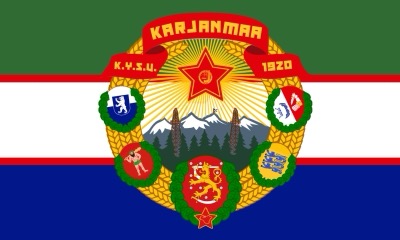
Pietari (Pietari) [ˈpie̯tɑri] is the capital and most populous city of the United Socialist States of Karjania. It is located on the shore of the Laatokka and Inkeri Lakes in northern Evria, where it's one of the region's largest cities. Its population exceeds 5 million, it's also the economic and cultural center of Karjania. Pietari doesn't belong to any subdivisions, its main administrative body is the Pietari City Council. Pietari has 5 football stadiums, a university, the largest square in Karjania and is the location where the Karjanian Communist Congress is held. It's also one of the historical centres of the traditional Routanmaa region, the most populated region in Karjania.
Etymology
The name Pietari is of Routan origin and is the equivalent of the Brantish given name Peter. Pietari was named after an Ancient Routan leader. During the medieval ages, it was commonly known as Pietarinjärvi, meaning “Peter's Lake” or Pietarinlahti meaning “Peter's Bay”. Most languages refer to Pietari by its native name, but some Karjanian Languages have their own names, including the Helkan Dialect, its speakers refer to the city as Suurjärvi meaning “Great Lake”.
History
After the Treaty of Roudanjärvi, Pietari became part of the newly created Karjan Confederation. It was only in the 1600s that it became the city of the Karjanian Royals, the new palace, now the national museum was built in 1623. Throughout this period, Pietari was economically the largest city in Karjania, but by population it was only 4th, behind Roudanjärvi, Arkankeli and Murmánska. Pietari was almost exclusively populated by wealthy, educated Karjanians which led to the creation of the Pietari Pedagogical Institute, commonly known as the University of Pietari, one of the most prestigious universities in Evria and the 2nd best in Karjania. In the early 18th century, Pietari saw a large rise in population and expanded rapidly in territory. By 1800, it was second only to Roudanjärvi in population and by far the richest city in Karjania. During the industrial revolution, Pietari's borders doubled in size after many surrounding villages were joined with Pietari and large rows of factories were built in the VII. District.
In the following years, Karjania's population tripled in size by 1900. Pietari overtook Roudanjärvi as the largest city by population in 1827, and by 1895 it had surpassed 5,000,000 inhabitants. During the Great War, Pietari lost around eight percent of its population but wasn't conquered. During the events of the Pietari Commune as Yriö Sinnar took power the city took heavy damage from communist revolutionaries. As the civil war went on, it was clear the communists would win and so around 20,000 people were executed in prisons and some in their own homes. The victims were either supporters of the Republic or relatives of former nobles. By 1921, all private businesses in Pietari were given to the state, as well as many new state owned companies being founded. Atso Toumola was elected in a faux election in 1924. In 1929, Pietari became the most literate city in Karjania according to government surveys.
Government
Pietari is governed independently of any subdivisions as it makes up the Capital Territory by itself. The main administrative body of Pietari is the Pietari City Council (Pietarin Kaupunginvaltuusto) in the Pietari Council Building. The council has 30 seats, with 25 elected representatives from the city's 25 districts and 5 chosen by the Government of Karjania. The mayor of the city is Also Tuomola, who is responsible for either approving or vetoing the council's decisions. In reality, the city government are puppets of the Karjanian Communist Party, the ruling party of Karjania.
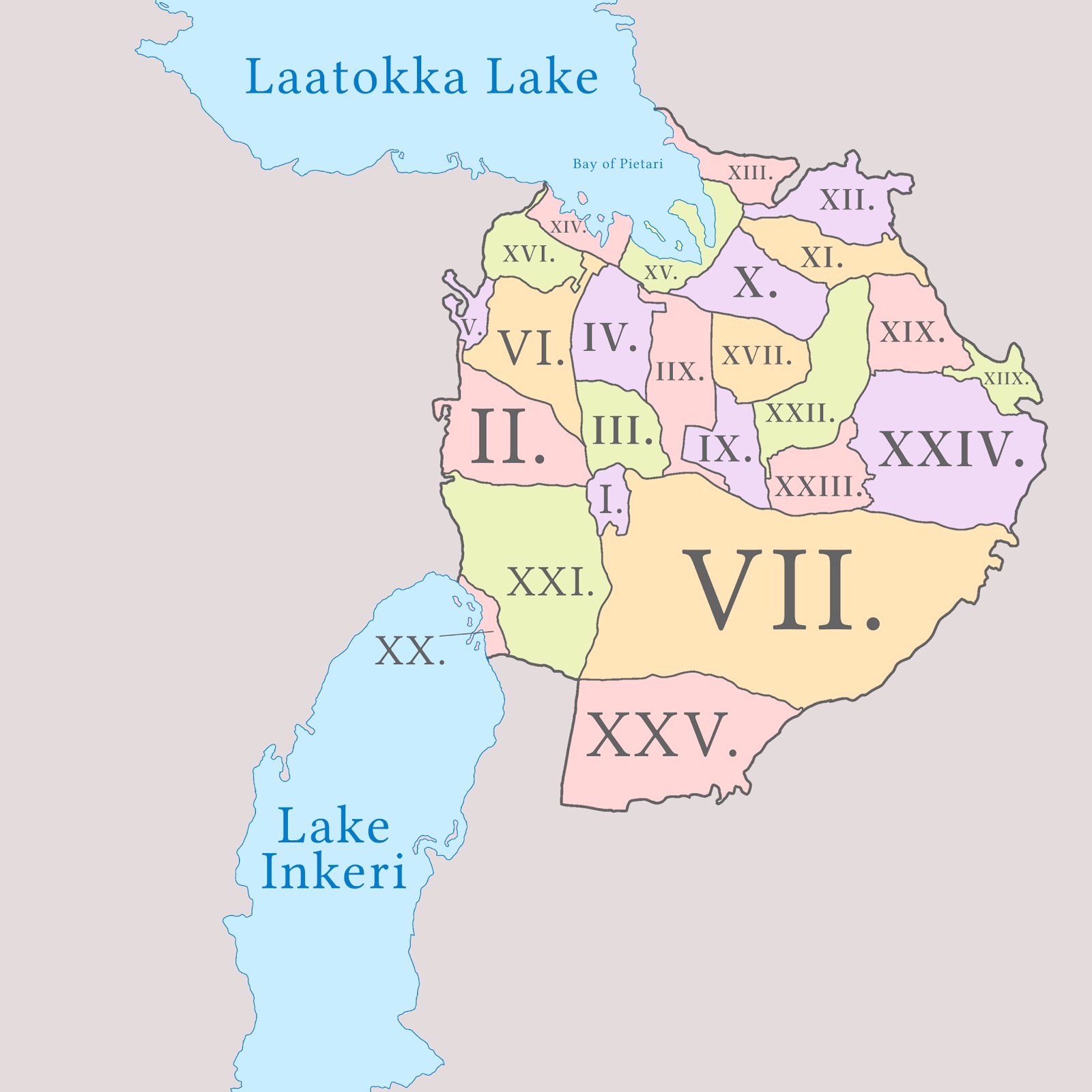
Pietari is divided into 25 districts (Kaupunginosat), which have no official names other than numbers. The districts were first created in the 1700s and later modified by the communist government. The districts differ in size, population and wealth.
Economy
Pietari is a large economic hub, the industrial centre of Karjania, with industries such as timber, mining, heavy machinery, vehicles and firearms. The city is home to companies such as Aallon Machinery Karjania, Karjanian Arms Company, and KRV. Other industries include minting, pharmaceuticals, shipbuilding, publishing and textile.
Pietari also has a large alcoholic beverage industry, with the focus being on vodka and beer. Alongside this, the city has a large construction business, mainly focusing on houses and roads.
The city has the strongest economy in Karjania, ahead of Roudanjärvi and. This is due to its geography, with plenty of natural resources as well as its geography. Pietari has a large number of factories, especially in the XV. VII. And XX. Districts.
Geography
Pietari is located between the Inkeri and Laatokka lakes, in the Routanmaa region of Karjania. Flowing through it is the Nevanvirta river, which starts in Lake Laatokka and flows into Lake Inkeri. Pietari has an area of 1439 km², and is the most densely populated city in Karjania. Pietari neighbours the Karjanian subdivisions of Laatokka State, Savio and Inkeria. It's located not far away from the Rudanian border. Pietari sits mostly around 50-100 meters above sea level, its highest point being around 180 meters. The city occasionally experiences floods from the river Nevanvirta.
The climate of Pietari is Humid Continental, meaning the average temperature is above the Karjanian average. In summer, it usually ranges between 15-20 degrees in summer with the highest temperature around 25-30 degrees Celsius. In winter, it can get as low as -20. Pietari is covered with snow over 100 days a year on average, as well as common rainstorms. The day length in the city varies massively based on the season and date.
Pietari has a relatively diverse fauna and flora, situated between two large lakes. In the forested outskirts of the city there is a large population of brown bears and beavers. In the Nevanvirta river lives the rare Pietari sturgeon, a subspecies of the common sturgeon. In terms of flora, Pietari's most common trees are conifers, as well as birch and oak. On the coasts of Inkeri and Laatokka live several species of birds.
Demographics
Pietari is a city populated mainly by Routans, with significant minorities being Helkans, Esti and Saamit people. In terms of religion, Pietari has a below average percentage of Nazarists, even for Karjania. In fact, despite having over twice the population of any other city in Karjania, Pietari is only second in the number of Nazarists. However, it has an above average percentage of people who follow Karjanian folk religions. Pietari has a majority female population at 52.9%.
The city's inhabitants are, on average, better paid than the rest of Karjania, as well as have a better quality of life. Most people live in government housing. The most common job in Pietari is as a factory worker. Pietari has more deaths than births and the median age is 27.
Culture
Pietari is one of the cultural capitals of Karjania along with Roudanjärvi. The city is home to the Karjanian National Museum, the historic Karjanian National Opera House, which was closed in 1928, the University of Pietari and several sports associations.
There are 4 professional football clubs in Pietari, the two largest being Pietari FK and XIV. District JK, these two have won the Karjanian Premier League multiple times. The third first division team is Laatokka JK, as well as third division 1830 Pietari, who played in a Karjanian Cup final in 1903. The city is also home to the Red Arena, the home stadium of the Karjanian National Team. Outside football, Pietari also has several ice hockey teams, a swimming association and a racetrack.
Culturally, Pietari is very similar to Roudanjärvi, with similar architecture and music. The cuisine of Pietari is infamous for its iconic dish, the Pietari cake, which consists of 25 layers of filling and dough each. The symbols of Pietari are 4 red and 3 white stripes. The three white stripes represent the Inkeri and Laatokka lakes as well as the Nevanvirta river, while the four red stripes represent the 4 edges of corners of the city. The colours of Pietari are red, yellow and blue, as seen on its flag adapted in 1921. Pietari is home to the Red Square, the largest open air square in Karjania which has a large red star in the center.