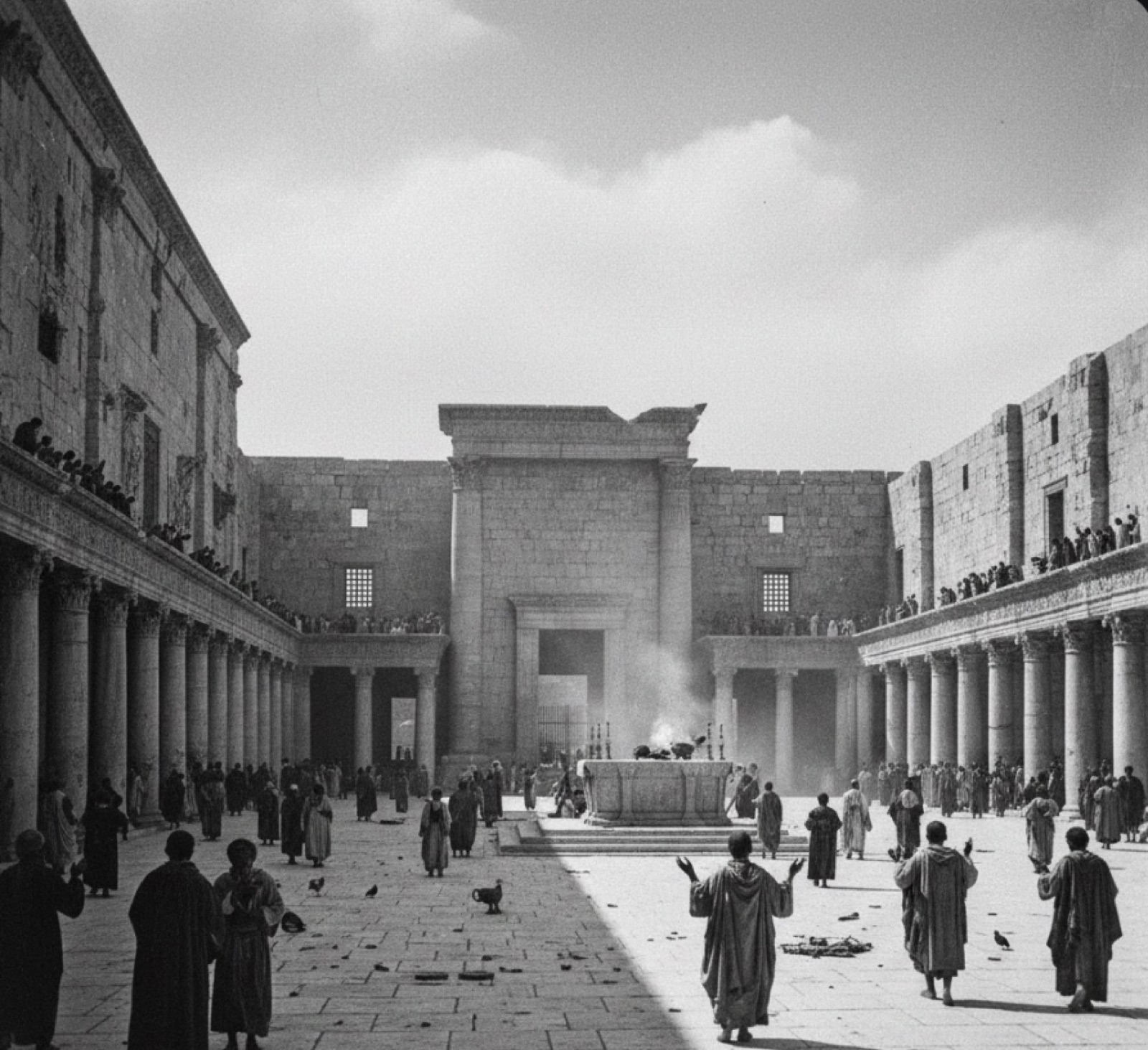
Eretz is the capital and largest city of The Order of Shivon. It houses the Great Temple, a structure dating back thousands of years to the era of the First Hasmenionian Empire. According to Hasmonean tradition, this is the site where God instructed Zechariah to establish the Temple.
The city’s origins trace back to around 5000 BCE, when the region was still the city-state of Hukar. During the expansionist campaigns of King Kazzamar, the settlement grew in size and importance as his conquests laid the foundations of the First Hasmenionian Empire. Hasmonean theology holds that Kazzamar was commanded to purge Hukar of pagan idols and establish the world’s first monotheistic faith. Following these events, the city was renamed Eretz. After the fall of the First Empire, Eretz changed hands repeatedly between 108 BCE and 708 CE, a period marked by foreign rule, decline, and widespread neglect. By the early 8th century, the city had deteriorated to the point of becoming a dumping ground.
In 709 CE, descendants of the Hasmenionian people recaptured the city, restored it, and re-established imperial authority, creating what became known as the Second Hasmenionian Empire. Eretz served as its political and spiritual center for centuries until the empire’s eventual collapse. The territory later came under the control of Shivonium, the predecessor state of modern Shivon. Today, Eretz functions as the administrative capital of the Order of Shivon and remains the holiest city in Hasmoneanism.
Etymology
The first time the name “Eretz” was ever heard, was in the Hasmoneanite Bible, as read:
“*And so I will give the Holy City, Eretz, your Zion, unto You. This will be the City of Worship, and you will be ever thankful…”
History
Archaeological and traditional accounts trace the foundation of Eretz to approximately 5000 BCE, when the region existed as the independent city-state of Hukar. Situated along early desert–sea trade routes, Hukar developed into a fortified settlement with growing regional influence. During this period, the population consisted largely of agrarian and proto-urban communities.
The city’s transformation began under King Kazzamar, who initiated extensive military campaigns that expanded Hukar’s influence across southern Evria. These conquests formed the core of what later became known as the First Hasmenionian Empire. Hasmonean theology holds that Kazzamar received a divine mandate to eliminate the traditional pagan cults of the region and introduce the first monotheistic religion. Following these reforms, Hukar was renamed Eretz, symbolizing its new religious and political identity. The construction of the Great Temple is traditionally dated to this period, and the city quickly became the empire’s ceremonial and administrative center.
After the collapse of the First Empire, Eretz experienced centuries of instability. From 108 BCE to 708 CE, the city passed repeatedly between rival powers, including neighboring desert polities and several short-lived regional kingdoms. Continuous conflict, neglect, and population displacement led to severe urban decline. By the early 8th century, contemporary sources describe Eretz as largely abandoned and functioning as a waste site for surrounding settlements.
In 709 CE, a coalition of groups identifying themselves as descendants of the Hasmenionian people launched a successful campaign to retake Eretz. After expelling foreign authorities, they initiated a large-scale reconstruction effort, cleansing the city, restoring its infrastructure, and re-establishing the Great Temple as the religious focus of Hasmonean life. This restoration marked the beginning of the Second Hasmenionian Empire, in which Eretz again served as the political and spiritual capital. The city became a major center of culture, scholarship, and theological development, maintaining its prominence for several centuries. The empire gradually weakened in the late medieval period due to internal conflict, economic stagnation, and factional rivalries, eventually collapsing in the 1500s.
Following the empire’s dissolution, Eretz became part of the new Shivonium, a successor state that controlled portions of the former imperial heartland. Although diminished politically, the city retained its religious significance and remained a symbolic center for Hasmonean identity. Shivonium’s rulers maintained the Temple complex, protected pilgrimage routes, and attempted to preserve the city’s historical continuity despite regional upheavals.
Eretz eventually became the core territory of the modern state of Shivon, which rose to political prominence in the early modern period and later transformed into the contemporary theocratic state known as the Order of Shivon. Under the current regime, Eretz serves as both the administrative capital and the holiest city of Hasmoneanism. The Directorate and its governing institutions operate primarily from within the urban center, while the Great Temple continues to attract pilgrims and remains the central symbol of the state’s religious identity. Today, Eretz stands as one of the oldest continuously inhabited cities in the region, consisting of layers of imperial rise and collapse, religious tradition, and modern authoritarian governance.
Government
Government and Administration
Eretz functions as the political and administrative center of the Order of Shivon. As the seat of national governance, the city hosts the institutions responsible for the formulation, execution, and enforcement of state policy. The most prominent of these is the Directorate Complex, a secured administrative district that houses the primary branches of the government. The Directorate Complex serves as the headquarters of the Directorate, the main governing body tasked with drafting legislation, implementing reforms, and overseeing economic and civil matters. The facility includes the offices of the Supreme Director and the Head Directorate, as well as numerous administrative departments involved in daily state operations. The complex is heavily fortified and subject to strict entry controls, reflecting the centralized and authoritarian nature of the regime.
Located adjacent to the Directorate’s administrative wing is the headquarters of the Department of Sense, one of the most influential security organs of Shivon. The Department is responsible for internal surveillance, ideological enforcement, suppression of dissent, and re-indoctrination programs. Its presence in Eretz underscores the city’s role not only as the political capital but also as the center of the regime’s intelligence and security apparatus.
Eretz also hosts the national Military Headquarters, which oversees the operations of the General Militarized Forces. From this command center, senior officers coordinate defense planning, mobilization procedures, and national security strategy. The proximity of the military leadership to both the Directorate and the Department of Sense shows the close integration of political, security, and military authority within Shivon.
Collectively, these institutions make Eretz the nerve center of Shivon’s state machinery, concentrating political power, administrative control, and national security functions within a single urban core.
Economy
The economy of Eretz is predominantly government-oriented, reflecting its role as the administrative and political capital of the Order of Shivon. A significant portion of the city’s infrastructure consists of government offices, ministry buildings, administrative facilities, and security institutions. As a result, most residents are employed in public-sector fields such as law enforcement, sanitation, civil engineering, administration, legal work, and technical services. Private enterprise is limited, heavily regulated, and largely subordinate to state priorities.
While Eretz handles governance, the bulk of Shivon’s practical economic activity takes place in the nearby city of Gonen, located within the same regional zone. Gonen functions as the state’s primary industrial and commercial hub, hosting factories, vehicle manufacturing plants, logistical centers, and majority of the nation's trade infrastructure. Goods entering or leaving Shivon typically pass through Gonen before being distributed to other regions, including Eretz. Eretz maintains strict political control, while Gonen feeds the practical economic functions necessary for the state’s continuation.
Geography
Eretz is located about 35 miles (56 km) west of the Saharan Sea. The city sits on several hills at an elevation of around 2,500 feet (750 meters) above sea level.
Right to the west of Eretz begins the Nabataean Desert, with dry valleys, rocky areas, and very little vegetation. Because of this location, Eretz stands between the usable highlands of central Shivon and the open desert.
Its position has made it an important area for trade routes and travel between the inland regions and the coast.
Demographics
Eretz has a majority population of Hasmenians, who in turn is a significant majority of the religion of Hasmoneanism, at about 98%.
The City also has a minority of Nabataeans, accounting for the other 2% of Eretz’s population, but is under current discrimination by the government.
2.1% of the population follows Nazarism, and has a large Church in the outskirts, named The Church of St. Mary.
Culture
Eretz is known for its traditional Matzah Ball Soup, and the song Havah Nagilacreated in 1915, became so popular in Shivon that it is considered a second national anthem and is still frequently played at celebrations.