

Thomas Illyon Binkowicz (born December 14th, 1882) is the current authoritarian ruler of Shivon. Before taking power, he was a political revolutionary who helped turn the government into the ultra-Ordalist regime it is now. Before politics, he led a street gang called the Stukes, known for their leather jackets and violent behavior. These early years shaped how he thinks and how he uses fear and loyalty. Binkowicz is a strong nationalist and believes Shivon must stay strict, controlled, and unified under his rule.
Early Life
Thomas Binkowicz was born on December 14th, 1882. His father was a mobster who operated through networks in Eshkarot, Davidica, Mohonon, and Rabba. Binkowicz rarely saw him, and when he did, his father was abusive and dismissive. The family lived in the Binkowicz Manor, where Thomas spent most of his childhood. At age 8, he was finally brought into his father’s underground headquarters and put to work as an alcohol dispenser, starting his life in the criminal world early.
Binkowicz did not attend regular school. He was taught at home by his uncle, Nimrod, who focused on basic education and a harsh personal philosophy centered on the belief that the strong survive and the weak perish.
At age 14, Binkowicz was involved in a violent fistfight with a group of older teenagers. After losing the fight, he was beaten by his father. When he turned 17, he was sent to collect a debt from a man who owed money to the gang. The man refused to pay, and the confrontation ended with Binkowicz beating him to death. He was arrested and sentenced to 23 years in prison, an event that became a major turning point in his life.
A few months later, a friend bailed him out. Shortly after returning home, Binkowicz got into a confrontation with his father, who attacked him in anger. Binkowicz responded by shooting his father, then turned him in to the authorities and received a reward for aiding in the case.
He then went to serve in the Shivonite Armed Forces, and accounts claimed he was emotionally detached from the rest of the troops.
Enlistment in the Military/The Incident
In 1909, Binkowicz was broke, directionless, and cut off from most of his former connections. With no real options left, he went to the nearest military recruitment office and enlisted. He passed the requirements without issue and began a 13-week training program. Binkowicz adapted quickly to military life, showing discipline, endurance, and a strong ability to follow orders. By the end of training, he was considered one of the most capable recruits in his group.
He was assigned to a base near Rabba, where his performance continued to stand out. Superiors noted his strict work ethic and his willingness to take risks that others avoided. Over time, this led to his promotion to the rank of Lieutenant.
During a short period of decommissioned leave, Binkowicz boarded a steamship traveling to Vicily. The trip was meant to be a plain break from military duty, and the ship carried families, workers, and travelers. What no one knew was that a gunman had snuck aboard earlier and had already placed an explosive device in the lower deck. The attacker blended in with the passengers until he was ready to act.
When the attack began, the gunman opened fire on the crew without warning. The crew attempted to stop him, but most were killed or badly injured in the first exchange. Panic spread quickly through the ship as passengers ran in different directions. With the bomb already set in the lower deck, smoke and heat started to build up inside the corridors. The attacker moved forward through the chaos while the ship began to tilt slightly from the damage below.
Binkowicz took cover behind a metal support beam and returned fire. He managed to wound the attacker in the right arm, slowing him down but not stopping him. With the crew unable to continue fighting, Binkowicz became the only person in position to resist. He moved toward the attacker, and the fight shifted into a close-range struggle. The ship’s floor shook as parts of the lower deck gave way from the explosion, making movement harder and adding more danger to the situation.
During the struggle, Binkowicz heard screaming from behind a collapsed section of the deck. A young girl had been trapped under debris from the earlier explosion. He pushed past the attacker long enough to pull the girl from under the wreckage and direct her toward the lifeboats. The attacker tried to stop him, but the injured arm slowed his reach, giving Binkowicz enough time to get the girl moving before turning back toward the fight.
As Binkowicz moved in to finish the confrontation, the attacker triggered a second explosive device strapped to his body. The blast threw Binkowicz across the deck and ripped apart part of the railing. He survived by diving behind a damaged section of the wall, but the explosion caused permanent hearing loss in one ear and left long scars across his chest. The blast also widened the damage to the ship, causing water to enter at a faster rate.
With the ship now sinking, passengers rushed to lifeboats as rescue vessels approached from nearby routes. Binkowicz, injured and half-deafened, pushed himself into the water and swam with the remaining strength he had. He and the girl he had saved were pulled aboard a rescue boat. His actions were later confirmed by witnesses, and the event became a major reason for his honorable discharge and the long-term financial support granted to him by the government.
Political Career
After Binkowicz was discharged from the military, he had no clear direction in life. The government provided him with a small house on the outskirts of Davidica, and with no other option, he moved in. During this period, he developed an interest in political manifestos and began spending long hours in the city library reading about different political systems and historical movements.
While studying, he learned more about Shivon’s ancient past, including the era when it was the Hasmenionian Empire—a large and powerful state that had collapsed long before his time. The fall of that empire and the reduced size of modern Shivon left a strong impact on him. Over time, he developed a deep resentment for democracies and monarchies, believing both systems were weak and corrupt.
In the back of the library, he found an old book describing the ideology of Ordalism, a political and nationalist doctrine focused on strict order and national strength, combined with religious unity. The ideas appealed to him immediately. In 1912, he publicly identified as an Ordalist. He began writing in his diaries, outlining his own political ideas, and he started distributing simple manifestos in public spaces to gather attention.
When the Great War began in 1914, Binkowicz first supported joining the conflict on the side of the Central Powers. As the war continued and he witnessed the destruction spreading through neighboring regions, his stance changed. He shifted toward supporting neutrality, believing Shivon would gain nothing by joining the fighting.
By 1919, Binkowicz had gained a small but growing following. Supporters believed his ideas could lead to a stronger and more unified nation. He promoted the concept of a “Third Hasmenionian Empire,” which he imagined would include most of the inhabited areas of Nabataea.
Around this time, he was invited to join an ultra-nationalist group known as For a Greater Empirate. The group helped spread his ideology, and membership increased into the thousands. Their support gave Binkowicz a larger platform and pushed him further into national politics.
He then began planning, along with several close supporters, to overthrow the current government and replace it with one based on their own ideas. As these plans developed, the group reorganized itself into an underground criminal network called the Stukes. The Stukes became known for their leather jackets, coordinated attacks, and heavy use of intimidation to control neighborhoods and silence opposition.
Current Reign
In 1926, when the Prosperous Coast forced the Empirate to scale back its harsh policies, Binkowicz saw his opening. Keeping himself and most of the Stukes hidden, he launched a series of coordinated terror attacks against senior government officials. These attacks increased the civil unrest already spreading across the country. The plan worked, and the Empirate collapsed shortly afterward.
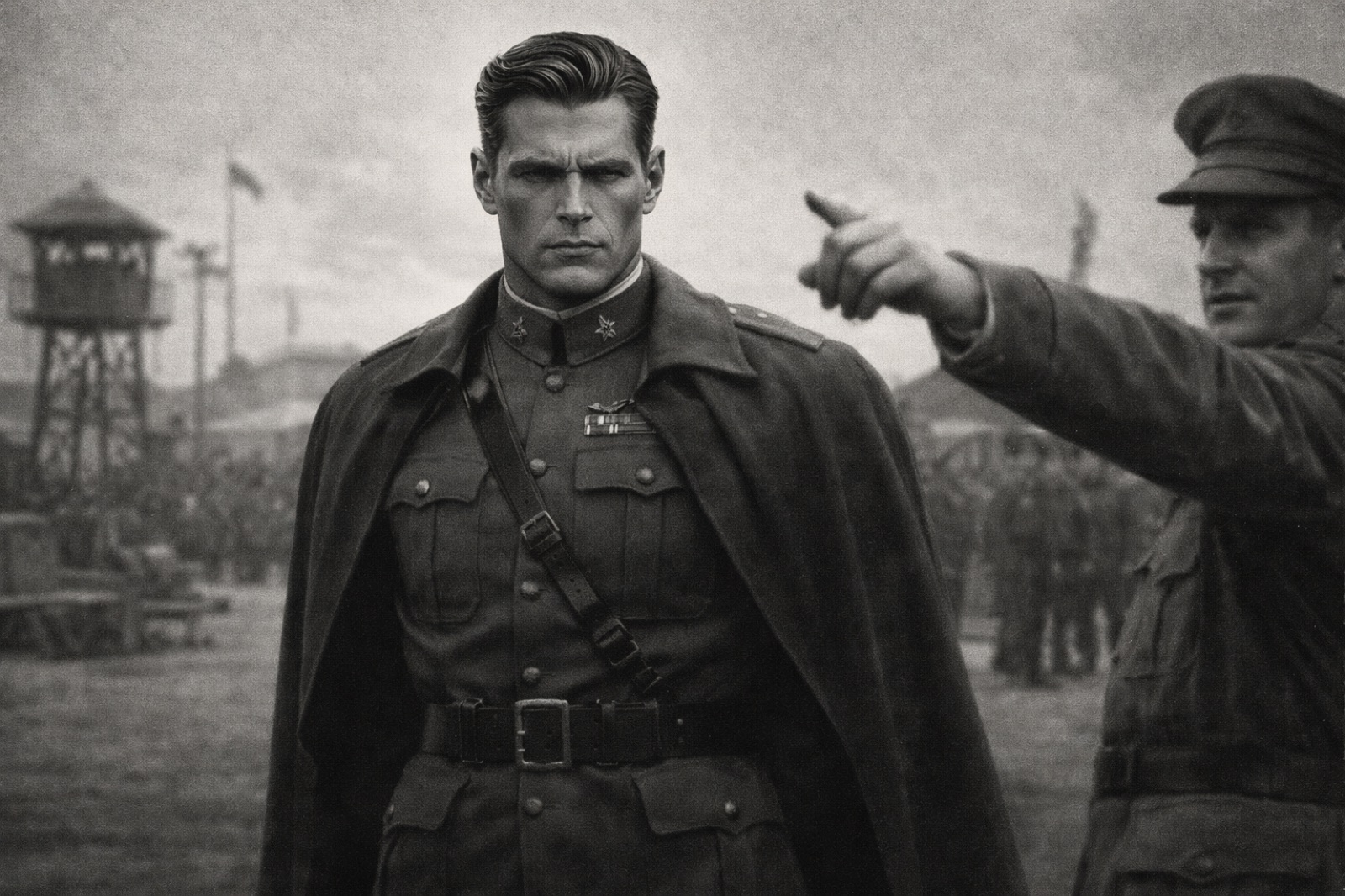
A Provisional Government replaced the old regime, but Binkowicz viewed it as just another obstacle. He repeated the same tactics he had used before, targeting judges, spreading unauthorized propaganda, and using fear to undermine public trust. Within 90 days, the Provisional Government fell as well. The population, desperate for stability, turned to him.
With the backing of the Stukes, Binkowicz convinced the public to elect him as the next leader. Once he won, he quickly consolidated his power. He introduced strict reforms to reshape the government, military, and economy. These reforms were difficult and unpopular, but over time they took effect and strengthened his control.
Under his leadership, tensions with several nations increased, but he managed to avoid open war. His regime continued to grow more rigid and centralized as he tightened his authority across the country.
Today, Binkowicz rules Shivon with an iron fist, and doesn’t intend to give it up anytime soon.
Personal Life
Binkowicz’s main residence is the Directorate House of the Supreme Leader, a large secured complex where he works, writes, and spends his private time. The building holds his office, personal library, and several rooms reserved only for him and his inner circle.
In private, he often smokes and listens to swing music. He drinks wine while reading newspapers and reviewing reports. His library contains rows of political manifestos, including his own earlier writings. During his free hours, he practices boxing to maintain his physical routine.
He also keeps his religion, Hasmoneanism, active in his daily life. He does not work on Saturdays and leaves all duties to his Second in Command for the day. He regularly visits the Temple in Eretz to take part in communions and religious gatherings.
Binkowicz also follows dietary rules and checks that his food is kosher before eating.
Characterization
Binkowicz is as cold and distant as you can get. In public and private settings, he rarely shows any emotion, and even when he attempts to appear expressive, his face usually stays rigid and unreadable. Those around him often note that he speaks in a flat tone and maintains the same calm posture regardless of the situation.
It is also pointed out that he shows signs of apathy and psychopathy. He shows no visible concern for the casualties caused by the genocide he ordered, and he treats the deaths as irrelevant to his goals. His lack of empathy has become one of the defining traits of his rule.